GeMarkt Blog · Essay
Two Kisses: Klimt’s The Kiss vs Rodin’s The Kiss
Compare Klimt’s gold painting with Rodin’s turning figures. See how gesture, surface, scale and viewpoint change two famous works called The Kiss.

Both works are called The Kiss, but they do not show the same embrace. Klimt wraps two people in a broad, glittering shape. Rodin lets their bodies turn around one another, leaving gaps that you could look through. One image holds you before a surface; the other rewards changing your position.
The title makes a useful invitation to compare, not evidence that the artists illustrated the same story. Klimt’s painting and Rodin’s sculpture are separate works, not versions of one composition. Within Rodin’s work, however, there really are different materials, sizes and casts. Knowing which object you are looking at changes the comparison.
The painting and the bronze side by side
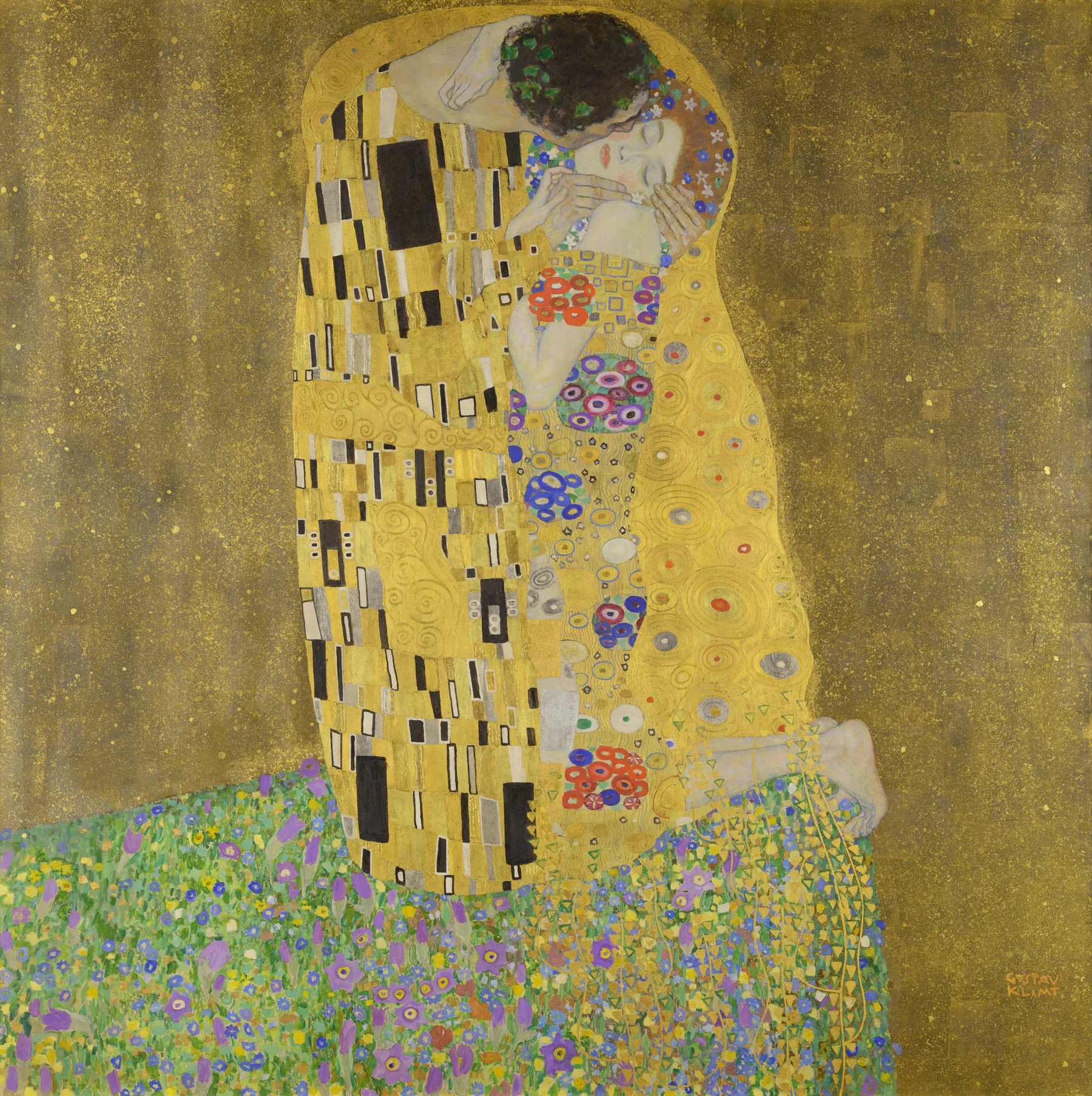

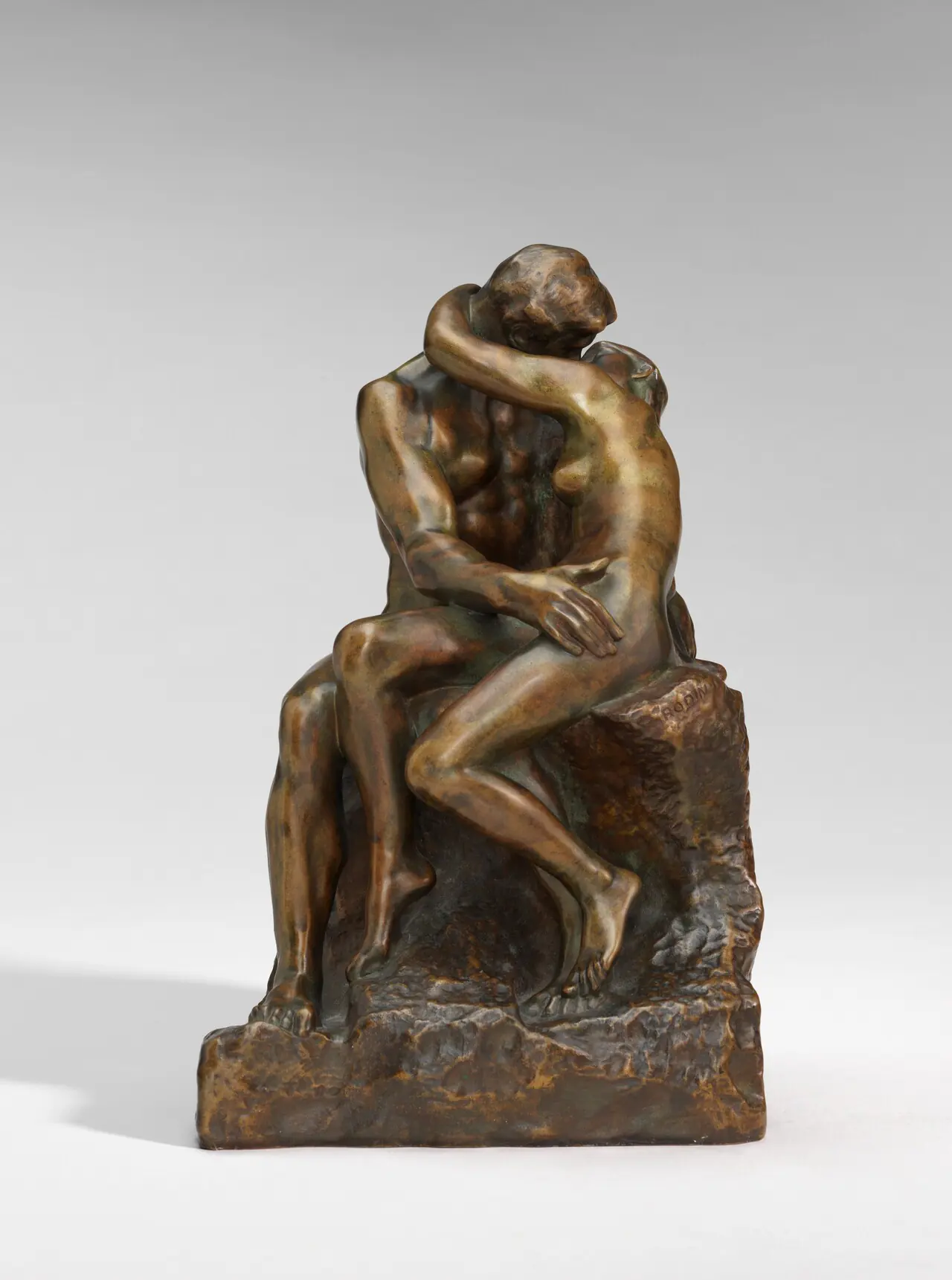
Begin at the outside edge of each pair of figures. Klimt’s people fit inside an almost continuous envelope. The dark rectangles on the left and coloured circles on the right help you distinguish the robes, but both belong to the same large gold shape. The figures seem separate and joined at once.
Rodin’s outline is less sealed. Knees project, an elbow turns outward, and an arm curves around a neck. You can follow one limb until it disappears behind another body. The sculpture gives you a small puzzle of overlapping forms rather than one uninterrupted silhouette.
These are observations about what is visible, not a code in which rectangles always mean masculinity or circles always mean femininity. The patterns make differences legible; they do not tell us everything about the people wearing them.
Follow the hands before the faces
In Klimt, the man bends down toward the side of the woman’s face. His hands frame her head; her fingers rest near his hand and neck. Her eyes are closed, and her face remains visible to us. The narrow areas of exposed skin stand out against the crowded patterning around them.
Now look at Rodin’s bronze. From this camera position, the woman’s raised arm hides much of the meeting of the faces. The man’s visible hand lies along her upper thigh. The figures turn inward, so their contact is described by the organisation of the entire body, not only by two mouths.
This is why reducing either work to a close-up of the heads can be misleading. Klimt’s feet, flowered bank and enclosing robe help establish the embrace. Rodin’s bent legs and shared seat explain how the bodies reach one another. The surrounding forms are not expendable decoration.
The gestures may feel tender, absorbing or uneasy to different viewers. A visible hand supports a discussion of touch; it does not prove a sitter’s private feelings or settle a modern psychological diagnosis. Staying with what can be seen usually makes the conversation more interesting.
Gold and bronze do different jobs
Klimt’s gold is material as well as colour. The Belvedere’s technical description distinguishes several metal leaves in the figures and a brass-based metallic background. A photograph records one appearance of those surfaces; it cannot reproduce every change as light catches the original.
In the painting, much of the background declines to behave like a deep landscape. There is no distant horizon giving the figures an ordinary address. The gold continues around them, while the flowered area supplies a small, sharply bounded place for their bodies.
The bronze’s brown and golden highlights work differently. Light catches a rounded knee, shoulder or back, helping us read volume. The rough base scatters light in smaller, interrupted patches. Its texture contrasts with the more continuous surfaces of the bodies.
Neither material is a simple substitute for the other. Turning a photograph of Rodin’s bronze into a flat brown silhouette would lose much of its volume. Removing Klimt’s pattern to reveal supposedly more important anatomy would dismantle the way his painting brings the figures together.
Walk around the sculpture

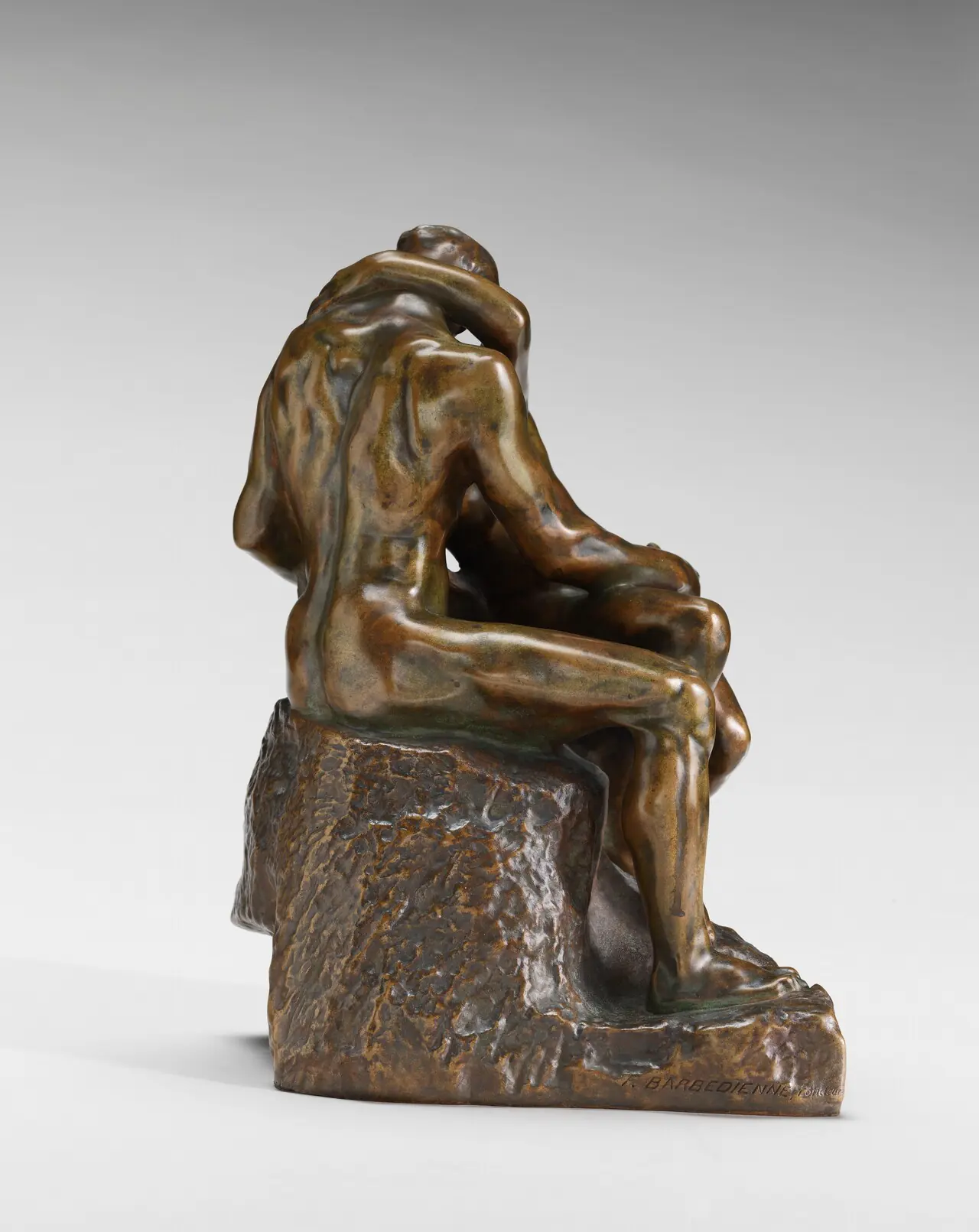

Changing the angle changes which body appears nearest. In the second photograph, the man’s back becomes a large surface and the woman is partly concealed. A dark opening beneath the arms is easier to see. The sculpture has not changed, but the relationships available to the viewer have.
This is more than a technical difference between two and three dimensions. It affects how long an encounter can last. Rodin’s work keeps offering another alignment. Klimt’s painting keeps your viewpoint on one side, then draws attention back through repeated patterns and small interruptions of skin.
A screen offers selected views of the sculpture, not a complete substitute for walking around it. The photographs above are useful precisely because they refuse to present a single camera angle as the whole work.
The story that Rodin left behind
Rodin originally connected the group with Paolo and Francesca, the lovers in Dante’s Divine Comedy. The Musée Rodin’s history explains that he developed it while working on The Gates of Hell, then removed it from that project and exhibited it independently in 1887. Its sensual happiness did not fit the surrounding conception of the gates.
The more general title The Kiss allows the embrace to be encountered without first recognising Dante’s characters. Knowing the story introduces a tragic background, but the sculpture does not show their punishment. The difference between the literary story and the chosen instant is worth keeping open.
Klimt’s object has another naming history. The Belvedere records its presentation as Lovers in 1908 and the title The Kiss in the museum’s 1909 catalogue. That shared later title is not evidence of a direct borrowing from Rodin. Similar subjects can invite comparison without a documented line of influence.
One painting and many sculptural versions
The bronze shown here belongs to the National Gallery of Art in Washington. Its record separates the model’s date from this cast’s approximate date. That distinction matters: designing a group and producing a particular metal object are not the same event.
It is not the monumental marble in Paris. The Musée Rodin dates the French state’s commission to 1888 and its marble’s carving to 1888–1898; that object measures 181.5 cm high. A photograph of that marble would need its own credit and permission. The open-access photographs here apply to the named Washington bronze, not automatically to every photograph of Rodin’s work.
Do not let the screen decide the scale
The two works can occupy similar rectangles on a phone even though Klimt’s canvas is 180 cm across and the illustrated bronze is less than 25 cm high. Comparing their apparent size on this page would therefore give exactly the wrong impression.
Imagine the painting extending across much of a wall, then imagine the bronze on a small stand. Intimacy is not necessarily a matter of small size: Klimt enlarges the embrace, while this Rodin cast brings a complex arrangement of bodies into a compact object. A larger Rodin version changes that physical encounter again.
Looking beyond a symbol of love
To compare the works, return to three concrete questions. What do the hands touch? Where can you see through or around the figures? What happens when light reaches the surface? These questions make the shared subject more specific without forcing one artwork to explain the other.
For a closer account of Klimt’s picture, continue with The Kiss: meaning, history and close looking. When another photograph of Rodin appears, check its material, size and collection before assuming it is the object seen here. The title opens the comparison; the particular objects make it worthwhile.
Editorial record
About this article
- Author
- Publisher
- GeMarkt
- Published
- Reviewed
- Internal source & rights check. Conducted by GeMarkt Research Review. This is an internal editorial check—not independent peer review.
- Source standard
- Art history source standardPrioritises object records and research sources, distinguishes evidence from interpretation, and states material uncertainty.
Found a claim that needs checking? Report a factual error.