GeMarkt Blog · Practical guide
Is Mondrian’s Art Public Domain? Start with the Exact Work
Compare two exact Cleveland CC0 Mondrians, from an early landscape to a 1927 composition. Learn why creation dates and familiar grids do not settle every right.
Rights check · reviewed
The short answer
Cleveland supplies exact CC0 files for its 1927 Composition with Red, Yellow, and Blue and about-1907 Field with Young Trees. Mondrian’s ordinary EU/UK painter term has elapsed. Independent U.S. publication histories remain unresolved; not all works or modern images are cleared.
| What is being checked | Result | Why |
|---|---|---|
| European Union — ordinary author term | Ordinary painter term expired after 2014 | Mondrian died in 1944. The ordinary life-plus-70 calculation has elapsed; national exceptions, moral rights, other contributors and later first-publication rights are not waived by that calculation. |
| United Kingdom — ordinary painting term | Ordinary painter term expired after 2014 | The ordinary life-plus-70 artistic-work rule has elapsed. Special rules for certain old unpublished texts, engravings or photographs must not be applied indiscriminately to paintings or ignored for other material. |
| United States — independent publication history | Check the exact work, not its creation year | This guide does not independently establish U.S. publication histories for the illustrated paintings. Institutional public-domain or CC0 designations are attributed. Neither a pre-1931 creation date nor a post-1930 date proves the outcome by itself. |
| Selected digital files | Two exact museum-supplied CC0 files | Cleveland 1967.215 and 1971.220 are supplied as CC0. Both exact print JPEGs, native dimensions and API records are preserved. The 1927 composition retains its original narrow grey frame; the landscape retains its complete photographed boundary. |
| Other works, editions and providers | Research links are not cleared downloads | Ten unacquired records remain HOLD for display. No whole-catalogue or worldwide clearance. Modern editions, translations, adaptations and photographs need their own evidence. |
Twelve exact research objects, with two acquired Cleveland CC0 images and ten research-only display HOLDs. Chicago’s 1935 Gray-Red public-domain flag is attributed, not treated as independently reconstructed publication or renewal evidence.
This is a documented research summary, not legal advice. Copyright and moral-rights rules can vary by country and by the history of a particular work.

What we’ll look at
Have you identified a particular Mondrian, or only a familiar-looking grid?
Short answer: Start with the individual Mondrian, not a blanket yes or no. Cleveland supplies CC0 files for the two works shown here: Composition with Red, Yellow, and Blue (1927) and Field with Young Trees in the Foreground (about 1907). Mondrian’s ordinary EU and UK author term has expired. This guide does not independently establish the U.S. publication histories of these paintings or clear every image bearing his name.
Piet Mondrian lived from 1872 to 1944. His black lines and primary-colour rectangles are instantly recognisable, but they are only part of his work. Landscapes, individual drawings, late compositions and modern products described as “Mondrian-inspired” need to be kept apart.
Which red, yellow and blue?
The opening image is Cleveland’s 1927 painting, accession 1967.215. Its full title is Composition with Red, Yellow, and Blue. Those colour words recur in Mondrian titles, so they are not a reliable identifier by themselves. This is the Cleveland painting, not an unspecified composition from 1930.
The canvas is only 49.5 centimetres square. A broad white space occupies most of it, while the colour gathers around the edges: two red areas at upper left, a thin yellow strip at right and a low blue rectangle. The black lines do not divide it into a regular chequerboard. Some spaces are narrow, others expansive.
Look at the blue rectangle along the bottom. Its weight is balanced by the reds above it, but they are not mirror images. That uneven balance is more interesting than the shorthand “straight lines plus three colours.” It gives the eye somewhere to travel instead of presenting a repeating pattern.
The museum identifies the narrow grey wooden strips as Mondrian’s original frame. The photograph retains them, along with the slight shadow underneath. This matters when choosing an image for an article: trimming everything outside the painted field would remove something that belongs to the object’s presentation, not just a distracting modern wall.
A landscape before the grid
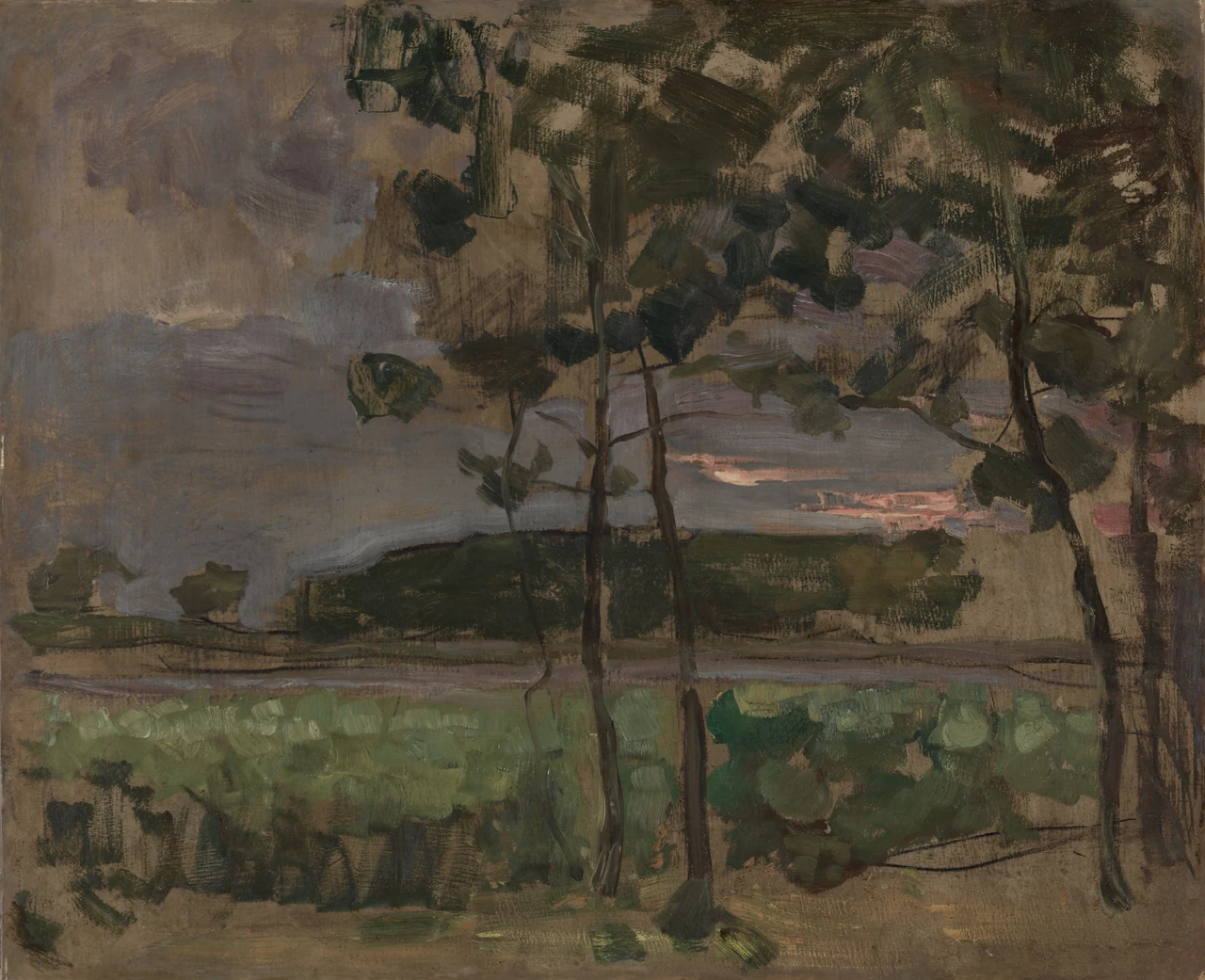
Piet Mondrian, Field with Young Trees in the Foreground, about 1907. The Cleveland Museum of Art, Gift of Frank Stella, 1971.220. Object record and CC0 image.
This earlier landscape is oil on paper laid on board, not a geometric canvas. Cleveland connects it with the countryside around Oele in the eastern Netherlands, where Mondrian spent time in summer 1907.
The thin trunks interrupt a broad strip of sky. Branches gather into dark clusters, while green strokes near the bottom suggest a field rather than describing every blade of grass. A small pink opening at the right keeps the horizon from becoming one continuous dark band.
You can compare its upright trees and low horizontal divisions with the later composition. That is a useful visual exercise, not proof that every tree was destined to become a black line. The loose handling, muted colour and uneven patches belong to this particular landscape and deserve attention on their own.
The two museum files show why an artist guide should not rely on one famous style. A search result that labels any brown landscape “early Mondrian” still needs an object record. Conversely, a red-blue-yellow pattern on a modern bag may be a new design rather than a reproduction of an identified painting.
Twelve different records
The table gathers twelve exact objects. The two Cleveland images are displayed here; the other ten are research links, not a cleared image pack. Dates follow the holding institutions, including their uncertainty. A provider’s public-domain flag describes its assessment and supplied material, not our independent reconstruction of first publication.
| Work and institutional record | Recorded date | What to keep separate |
|---|---|---|
| Lozenge Composition with Yellow, Black, Blue, Red, and Gray | 1921 | A diamond-shaped composition, not the Cleveland square canvas. |
| Farm near Duivendrecht | About 1916 | A distinct landscape, Chicago 2001.479. |
| Composition (No. 1) Gray-Red | 1935 | Chicago flags this record public domain; independent U.S. reasoning unresolved here. |
| Landzicht Farm: Compositional Study | About 1905 | A study, not a substitute file for another farm picture. |
| Study for a Composition | 1940–41 | Later study; retain its individual object record. |
| Geinrust Farm: Close Frontal View | About 1905–06 | Different farm and viewpoint. |
| Amsterdam Skyline Viewed from the West | About 1899 | A named city view rather than an abstract grid. |
| Windmill with Summerhouse II | About 1906 | Met record; no open image acquired here. |
| Tableau | 1921 | Met 1999.363.57, not the Chicago lozenge. |
| Untitled (River Landscape with Bridge) | About 1897–1907 | Broad dating retained; no guessed single year. |
| Composition with Red, Yellow, and Blue | 1927 | Illustrated Cleveland CC0 file. |
| Field with Young Trees in the Foreground | About 1907 | Illustrated Cleveland CC0 file. |
Why the country matters
For Mondrian’s own paintings, the ordinary EU life-plus-70 calculation runs from his death in 1944 through the end of 2014. The UK’s ordinary artistic-work term also uses life plus seventy years. This is an ordinary author-term conclusion, not a statement that national exceptions, moral rights or newly arising publication rights never matter.
U.S. dates work differently. The Copyright Office’s current duration circular identifies works published in the United States before January 1, 1931 as public domain. A canvas painted in 1927 is not automatically evidence of publication in 1927. Foreign publication, registration and a work’s previously unpublished status can affect the route to an answer.
For example, section 303 gives some qualifying older, previously unpublished works a minimum term through 2047 when publication occurred by the end of 2002. That is a conditional rule, not a claim that every posthumously reproduced Mondrian is protected until 2047.
A later date is not an automatic no
It is tempting to reverse the cutoff and declare everything made after 1930 protected. That is also too crude. Chicago’s record for Composition (No. 1) Gray-Red, dated 1935, carries a public-domain flag in the museum’s current collection data. This guide reports that designation without inventing a renewal, publication or other legal history to explain it.
At the other end, the Met records linked above do not supply us with an approved open image simply because their objects are earlier. Provider policies and underlying copyright are related checks, not interchangeable answers.
A celebrated late work such as Broadway Boogie Woogie, 1942–43, therefore needs its own research. MoMA’s image is not one of the files reproduced here. The painting also shows why chronology matters artistically: its small coloured segments create a different rhythm from the thick continuous black lines in the Cleveland composition.
Using the image without changing the work
Cleveland’s Open Access policy applies CC0 to designated images and data, including the two selected records. Save the object number, exact file link and rights statement with the image. Do not treat that permission as a museum endorsement of your product or extend it to someone else’s photograph.
Check orientation before making a layout. A lozenge painting should not be turned into a square merely because a thumbnail slot is square. Preserve the narrow colour strips in the 1927 composition; an aggressive crop could remove the yellow entirely and leave readers with a different balance of colour.
Finally, distinguish a faithful reproduction from a new design. The closer a caption stays to the actual object—title, date, medium, collection and source—the easier it is to see what is genuinely Mondrian, what the museum supplied, and what a modern designer has added.
Sources and review method
We checked the artist chronology against museum records, treated each named jurisdiction separately, and recorded the provider policy for the image set. These sources support the legal framework and artist dates used above; the source file for any individual image still needs its own record.
- Composition with Red, Yellow, and Blue, 1967.215 — The Cleveland Museum of Art. Exact 1927 square canvas, original frame and CC0 source; not the similarly titled 1930 painting.
- Field with Young Trees in the Foreground, 1971.220 — The Cleveland Museum of Art. About-1907 work on paper laid on board, Oele context and exact CC0 source.
- Open Access — The Cleveland Museum of Art. Designated image/data CC0 terms, without extension to unrelated rights or institutional endorsement.
- Composition (No. 1) Gray-Red, 1949.518 — Art Institute of Chicago. 1935 date and current public-domain provider flag; independent underlying U.S. chain unresolved.
- Broadway Boogie Woogie, 73.1943 — The Museum of Modern Art. Identified late 1942–43 comparison; its image is not acquired or licensed by this guide.
- Directive 2006/116/EC, author term and later publication rights — EUR-Lex. Ordinary life-plus-70 calculation; national exceptions and later first-publication rights remain separate.
- How long copyright lasts — UK Intellectual Property Office. Ordinary artistic-work term, not a universal answer for every kind of archival material.
- Duration of Copyright, Circular 15A, April 2026 revision — U.S. Copyright Office. Pre-January-1931 U.S. publication cutoff in 2026; publication is not the painting date.
- 17 U.S.C. Chapter 3, including section 303 — U.S. Copyright Office. Conditional treatment of formerly unpublished works; no blanket 2047 conclusion.
Editorial record
About this article
- Author
- Publisher
- GeMarkt
- Published
- Reviewed
- Internal source & rights check. Conducted by GeMarkt Research Review. This is an internal editorial check—not independent peer review.
- Source standard
- Rights guide source standardSeparates the underlying work from the source file, records the review date, and links the evidence used for the conclusion.
Found a claim that needs checking? Report a factual error.