GeMarkt Blog · Practical guide
New Year Art: Fresh Starts and Japanese Prints
Choose a Japanese print for a new-year refresh, from Hokusai’s Red Fuji to Hiroshige’s fox fires, without confusing a personal association with its history.

For a new-year refresh, choose one Japanese print whose composition you enjoy, not a collection of supposed good-luck symbols. Hokusai’s red mountain can mark a fresh start for you without being a New Year picture. Hiroshige’s fox fires, by contrast, depict a specific New Year’s Eve tradition. Their histories make the choice more interesting, not more restrictive.
The practical question is what you want to change at home: a crowded wall, an empty corner, or a picture you no longer look at. A new print can help, but moving or reframing something you already own may do the job equally well. Start with the room rather than the calendar.
Decide what you want to change
Take down temporary holiday decorations before judging the wall. A space that seems empty immediately after lights and cards disappear may simply be easier to see. Live with that view briefly before deciding it needs several replacements.
Name one useful change. You might want a clearer view from a desk, a vertical image for a narrow wall, or fewer small frames around a television. Each is more specific than “make the room feel new,” and each will lead to different proportions and levels of detail.
Avoid turning a print into a promise about the year ahead. An image can remind you of a walk, an ambition or a place you hope to visit. It cannot guarantee prosperity or peace, and a Japanese subject does not automatically carry the meaning assigned to it in an online caption. Keep your personal association alongside, rather than in place of, its actual title and story.
Red Fuji makes one strong shape
Hokusai’s South Wind, Clear Sky, often called Red Fuji, belongs to Thirty-six Views of Mount Fuji. The Metropolitan Museum dates this impression to about 1830–32. The red mountain, blue sky and pale horizontal clouds make it a very different wall image from a densely populated landscape.
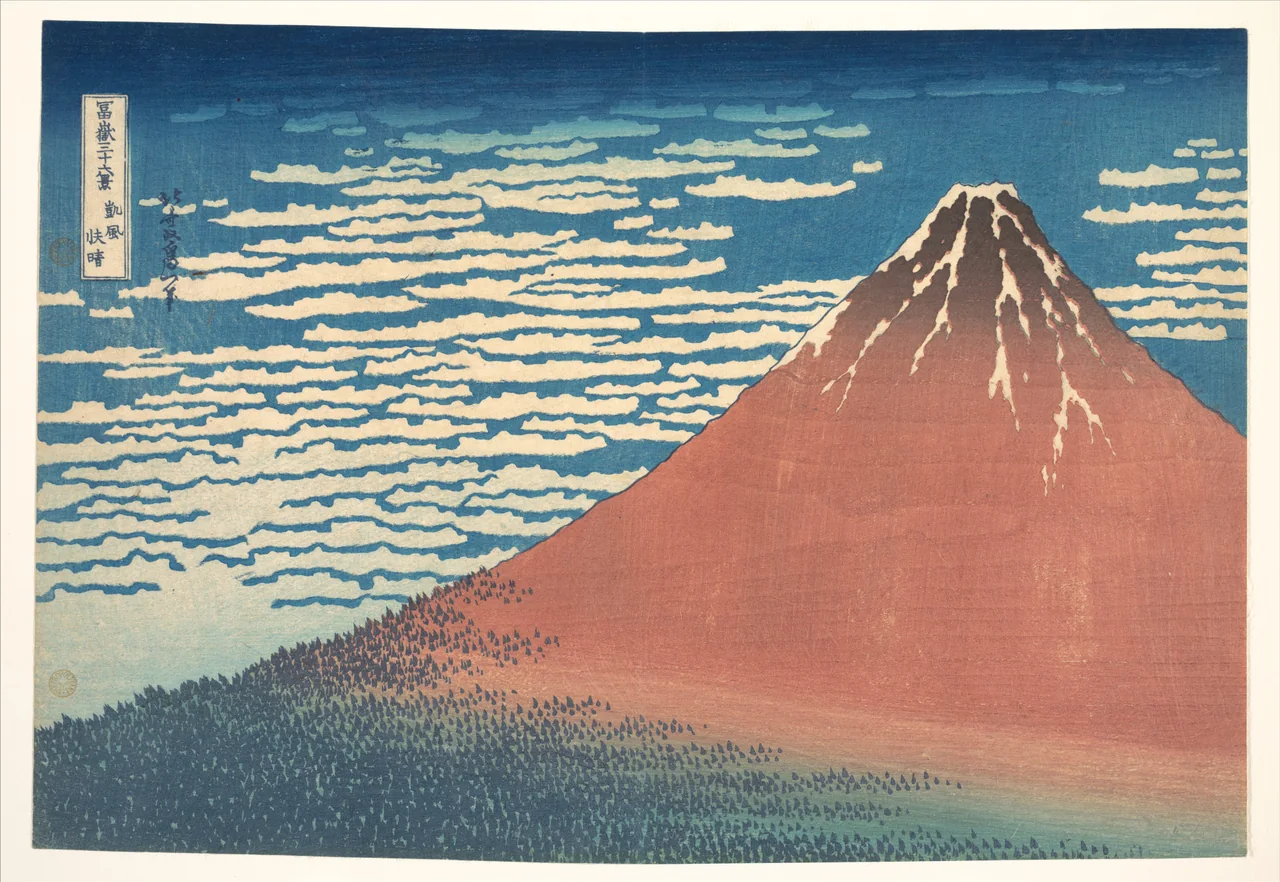
For a room that already contains many small objects, the mountain’s broad slope offers a strong shape you can recognise from a distance. Its red need not be repeated around the room. If a red cushion makes the arrangement feel too coordinated, try leaving the print as the only substantial red area.
The tree-covered base and clouds still matter. Cropping tightly around the peak makes a different composition, and a square crop may remove the space that lets the mountain rise. Choose a reproduction that preserves the print, then fit the frame around that shape.
This is not presented here as a documented New Year commission. You can choose it as an image of a beginning, a journey or a clear horizon, but that is your association with the work rather than a claim about Hokusai’s purpose.
The fox fires have a real New Year story
Hiroshige’s New Year’s Eve Foxfires at the Changing Tree, Ōji, about 1857, supplies a more direct connection. The Met describes foxes gathering at an old tree before visiting the Ōji Inari shrine. Farmers interpreted the fox fires as signs for the coming rice harvest. This is a particular place and tradition, not a general explanation of every fox in Japanese art.
Its New Year followed the traditional lunisolar calendar, not today’s December 31–January 1 dates. Japan adopted the Gregorian calendar in 1873, as the National Diet Library explains.
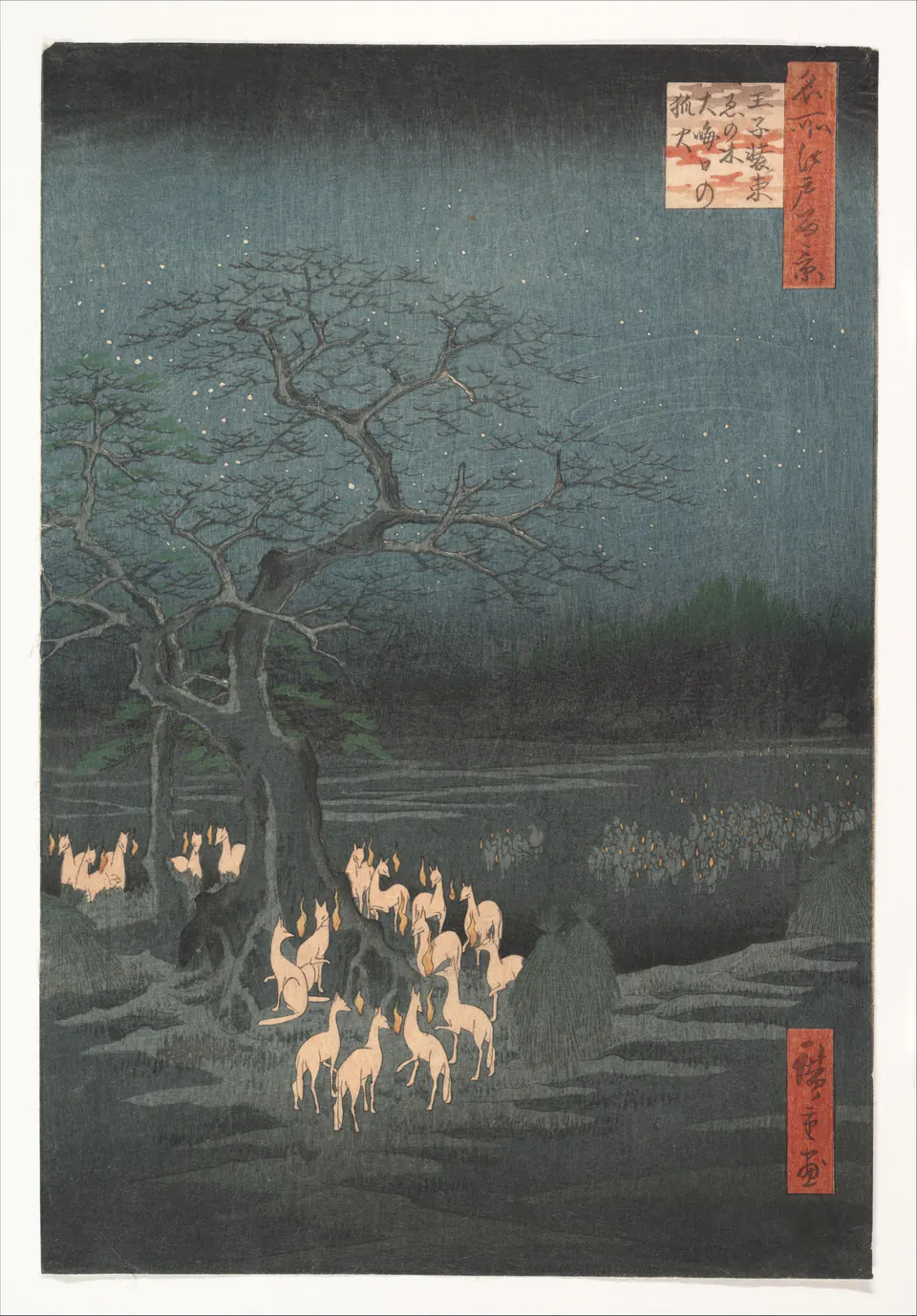
The illustrated impression has a large, dark upper area and small pale animals near the bottom. Place a reproduction where the lower part will not be hidden by a tall lamp, a plant or objects on a cabinet. A tiny thumbnail can make it seem almost empty, while a closer view reveals the line of lights extending into the distance.
Do not brighten the whole file until the night disappears. If the darker shapes are hard to distinguish in a prospective reproduction, compare it with the source and ask for a clearer preview. A different print may suit a poorly lit position better than an aggressively altered version of this one.
Plum blossom offers a different seasonal view
Hiroshige’s Plum Garden at Kamata, 1857, is another possible refresh, but it is not the same kind of New Year subject. The picture shows flowering trees and visitors in a garden. Its blossom can be a personal association with renewal without making it an illustration of January 1.
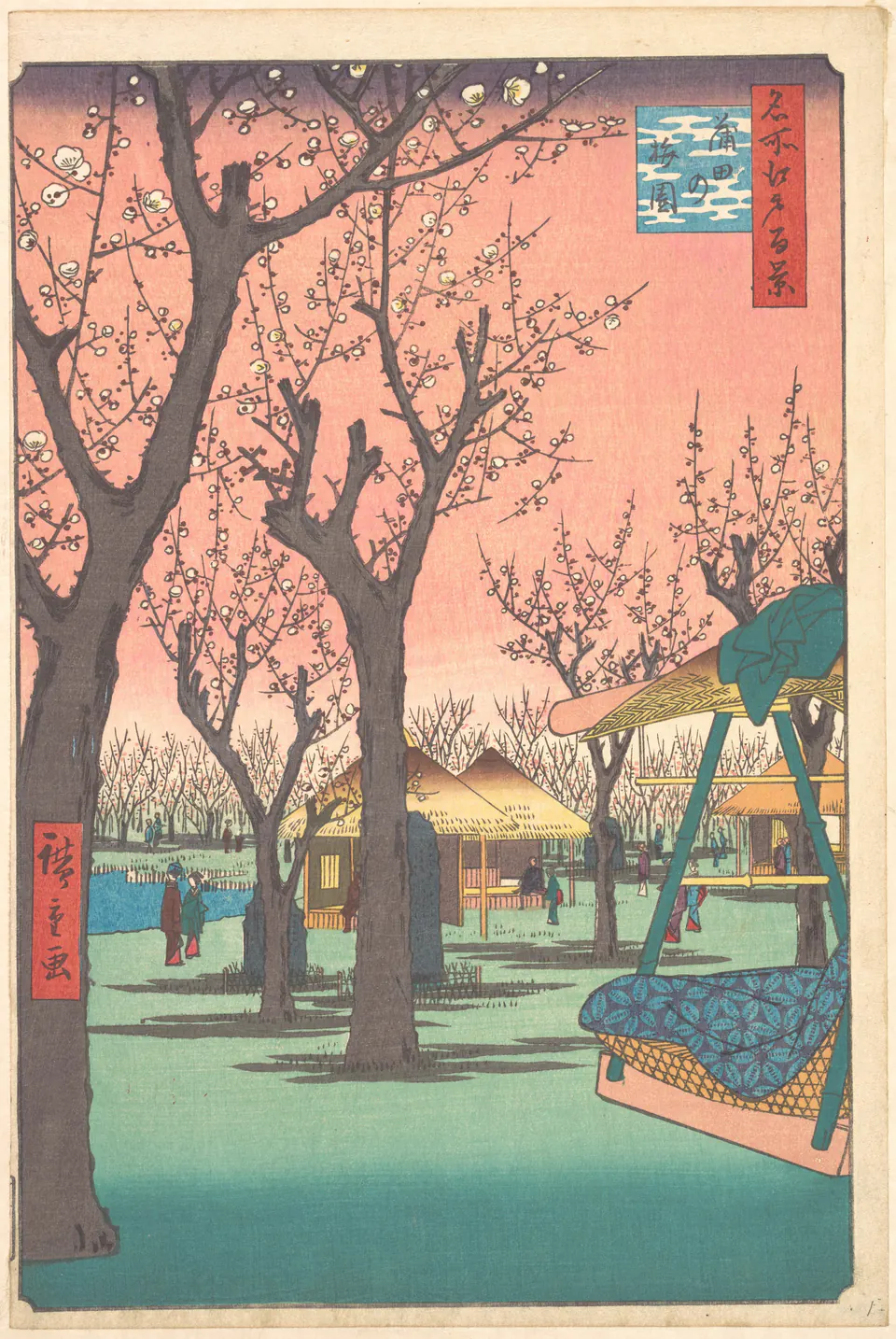
The foreground trunks are large, but many blossoms are tiny. The pink sky supplies a broad field of colour while the trees and path create smaller rhythms. This combination works differently from Red Fuji: it rewards a position you can approach rather than relying entirely on one distant silhouette.
Its tall shape may fit beside a doorway or above a narrow cabinet. Do not assume that a large portrait-format frame means a large printed image, though. Wide margins can leave a comparatively small garden in the middle. Check the actual image dimensions as well as the frame’s outside measurements.
Keep the print whole
Japanese prints can include titles, signatures, seals and visible paper around the design. Those details are not automatically unwanted marks. Compare the complete source image with the proposed reproduction before deciding that an unusually clean-looking version is better.
Check which impression you are looking at, too. The same design can survive in different impressions whose colour and condition vary. For the examples here, the collection and accession number in each caption identify the illustrated object. Keep that information when choosing a file; a matching short title alone does not identify the same image.
For framing, distinguish the paper sheet, the printed image and the mat opening. Ask whether anything important will be concealed. A border can help fit the complete image into an available frame; stretching the design or quietly cutting off the title should not be the default. Our guide to art print sizes explains these separate measurements.
Make a pair without forcing a match
If you want two prints, choose a relationship beyond “both Japanese.” Red Fuji and Plum Garden at Kamata share substantial pink-red areas but use space differently. The mountain is horizontal and concentrated; the garden is vertical and intricate. They can belong in the same room without becoming identical rectangles.
Try placing them on separate walls before forcing them into a pair. If they will hang together, compare the outer frames and visible image areas on paper. Two frames can share a top edge while the pictures keep their original proportions, or a single picture can occupy the main wall with the second elsewhere.
A good first experiment is to remove the nearby object that competes most strongly with the print. You may need less colour and fewer frames, not a larger purchase. Let one change remain visible long enough to decide whether it helps.
Choose a refresh that can last
Before printing a file, verify its specific reuse terms and whether the supplied resolution suits the intended image size. The museum images shown here carry Open Access public-domain designations; that does not describe every file offered under these titles. Nor does an online illustration promise that a particular size or finish is available to buy.
Keep the artist, title, collection and source together with the print. That makes a later change of frame or replacement copy easier, and lets the story remain attached to the image rather than being replaced by a vague slogan about luck.
Choose Red Fuji for its broad shape, the fox fires for their specific New Year’s Eve story, or the plum garden for its branching detail. The best fresh start is a room where you can see and enjoy what you chose, even after the novelty of the new year has passed.
Editorial record
About this article
- Author
- Publisher
- GeMarkt
- Published
- Reviewed
- Internal source & rights check. Conducted by GeMarkt Research Review. This is an internal editorial check—not independent peer review.
- Source standard
- Buying guide source standardSeparates measured or first-hand evidence from general guidance and keeps practical limits visible.
Found a claim that needs checking? Report a factual error.