GeMarkt Blog · Reference
Is The Sleeping Gypsy by Henri Rousseau Public Domain?
Rousseau’s 1897 painting, the exact Commons image and MoMA’s separate licensing route: what is clear, and what the U.S. publication record still needs.


The short answer
Rousseau’s ordinary life-plus-70-year author term has expired, and the exact reproduction used here carries a public-domain assessment on Wikimedia Commons. That does not make every MoMA photograph a free download or establish a universal permission for every use.
We mean The Sleeping Gypsy, 1897, Museum of Modern Art accession 646.1939—not a modern recreation of the scene. This check, current to 12 October 2026, distinguishes that painting from a particular Google Art Project-source reproduction. Its Commons status is documented; an independent U.S. publication analysis of the underlying painting remains incomplete.
The painting this check covers
The MoMA object record identifies the work as oil on canvas, 129.5 × 200.7 cm, a gift of Mrs. Simon Guggenheim. The French title, La Bohémienne endormie, identifies the same composition.
Use the accession when comparing records. A retailer may shorten the title, translate it differently or offer a detail without saying so in a search preview. Matching the title is a start; matching the actual scene and collection number is much stronger.
The historical title is retained here so readers can locate the painting. It should not be treated as a verified identification of a real sitter or a licence to invent an ethnographic account of the scene. Our visible subject is a sleeping figure, an animal and objects arranged within an imagined night landscape.
Keep the lion and the moon in the picture
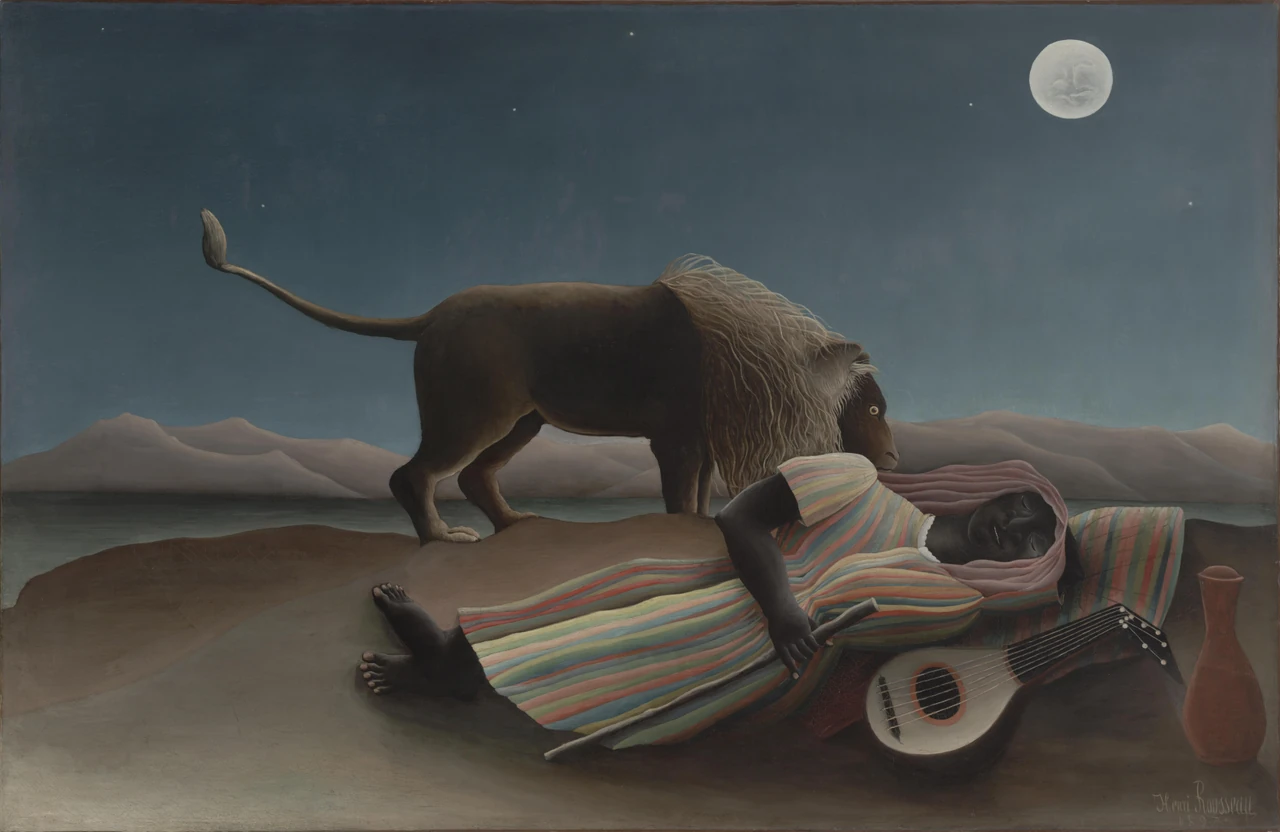
The lion stands across the middle of the painting, its body mostly horizontal and its head lowered towards the sleeper. Below it, the striped robe makes a second, more colourful band. Behind both, the distant hills repeat a low, uneven line. These layers let the scene feel still without making it empty.
The moon is near the upper right corner. It has far more open sky around it than the foreground objects have empty ground. A square crop centred on the sleeping face can lose that imbalance, turning an expansive nocturnal scene into a close encounter between two heads.
The mandolin and upright vessel matter visually as well. They anchor the lower right while the lion’s tail reaches towards the opposite side. A detail can be useful when discussing either object, but it should remain a detail, labelled and accompanied by the complete image.
In this reproduction, the sky and ground are muted while the garment carries fine coloured stripes. Brightening every dark area indiscriminately changes their relationship. That may be a deliberate new design choice; it should not be presented as the recovery of Rousseau’s “true colours” without evidence.
An old author term and an exact digital file
Rousseau died in 1910, as the museum’s attribution records. His ordinary seventy-year author term is over under UK guidance. The standard French rule reaches the end of 1980 on that calculation. Neither is a universal ruling on every jurisdiction or later image.
The selected Commons record identifies the exact 6,797 × 4,416-pixel file and its Google Art Project source. Its current upload dates to 18 June 2015. Commons marks it as a faithful reproduction of a public-domain two-dimensional work and applies the Public Domain Mark, including a U.S. pre-1931 assessment.

One source detail needs correcting rather than repeating: the page’s rights template gives 1919 as the artist’s death year, while its own creator information and MoMA give 1910. Our calculation uses 1910. That discrepancy illustrates why a rights badge should be read with the object record, not treated as a substitute for it.
The Public Domain Mark is an assessment of status, not a new licence from every possible rightsholder. It carries jurisdictional and other-rights limitations. We therefore retain its source and scope instead of rewriting it as “MoMA granted worldwide CC0”.
MoMA’s licensing route is separate
MoMA’s current object page directs requests to reproduce its artwork images to Art Resource for North America or Scala for other territories. It does not offer this object as an institutional CC0 download.
Our reproduction is the separately documented Commons file, not an image acquired through that licensing service and stripped of its conditions. If you need a particular new institutional photograph, use the museum’s stated route for that supply.
These two routes can coexist. A painting’s age, a repository’s status assessment and a museum’s image-supply service answer different questions. The practical mistake is to download one file while attaching a permission statement that belongs to another.
What the ownership history does and does not prove
MoMA records John Quinn’s purchase on 16 February 1924, followed by a sale from his collection at the Hôtel Drouot on 28 October 1926. Those dated transactions are useful leads. They are more specific than simply pointing to the year painted or to the 1897 exhibition.
They do not, by themselves, complete our legal research. We have not reconstructed the relevant authorisation and publication circumstances or inspected a qualifying early illustrated edition for this guide. Ownership history and publication history overlap in places, but are not interchangeable lists.
The U.S. Copyright Office distinguishes exhibition alone from publication and recognises that authorised sale or distribution can matter. The duration provisions also distinguish older published works from works previously unpublished. Our U.S. conclusion remains the documented Commons assessment, not a separately completed opinion.
An older image is not a new restoration
MoMA’s conservation feature, published in March 2020, describes the removal of earlier treatments as revealing the painting anew. The Commons file used here was already uploaded in 2015. It should not be captioned as a new post-treatment photograph.
That does not make an earlier reproduction unusable. It makes the capture history part of an honest description. An older image can document how a painting appeared before later treatment; a newer one may show a different surface presentation.
If two images differ, compare their dates, sources and visible details before declaring one authentic and the other fake. Display settings and later processing can also affect the comparison. A rights record tells you where a file came from and what its source says about reuse; it does not guarantee that every screen will show the same colour.
Using the work without misrepresenting it
Keep the full composition for an introduction to the painting. When a passage concentrates on the mandolin, stripes or lion, a labelled detail may help, but it should not replace the whole image without explanation. Avoid extending the desert or inventing new stars and then calling the result the complete painting.
A useful credit names Henri Rousseau, The Sleeping Gypsy, 1897, MoMA 646.1939, and identifies the exact Commons source. Do not use the museum’s name or logo to imply approval of a reproduction, article or product.
For a substantial commercial project, settle the remaining jurisdiction and publication questions for the intended market and chosen supply. For readers of this guide, the essential distinction is already clear: the old painting, this documented earlier reproduction and a newly supplied museum photograph are not the same rights question.
Editorial record
About this article
- Author
- Publisher
- GeMarkt
- Published
- Reviewed
- Internal source & rights check. Conducted by GeMarkt Research Review. This is an internal editorial check—not independent peer review.
- Source standard
- Rights guide source standardSeparates the underlying work from the source file, records the review date, and links the evidence used for the conclusion.
Found a claim that needs checking? Report a factual error.