GeMarkt Blog · Reference
Is The Fighting Temeraire by J. M. W. Turner Public Domain?
Separate Turner’s 1839 painting, its early engravings and a CC BY photograph from the National Gallery’s restricted image downloads.


The short answer
Turner’s ordinary UK and EU author copyright term has expired. The photograph on this page is separately offered by its photographer under CC BY 3.0. You can follow that file’s licence; you should not assume that a National Gallery website download has the same terms.
This check, current to 12 October 2026, concerns NG524, the 1839 oil painting. Nineteenth-century publication of engravings is documented, but this guide does not claim a completed, independent U.S. clearance of every historical state or reproduction.
1838 in the title, 1839 on the record
The National Gallery identifies the painting as The Fighting Temeraire tugged to her last berth to be broken up, 1838. Its creation date is 1839. The year in the full title refers to the ship’s last journey, not to when Turner finished the picture.
The museum records oil on canvas, 90.7 × 121.6 cm, inventory NG524, acquired through the Turner Bequest in 1856. The composition was exhibited at the Royal Academy in 1839. These details help distinguish it from a print after Turner or a later painted copy.
The Temeraire had fought at Trafalgar in 1805. Here its destination is a shipbreaker, not a new battle. The museum cautions that Turner probably did not witness the tow and reconstructed the scene imaginatively. The picture should therefore not be described as a mechanically accurate eyewitness record of that evening.
For other works and file examples, see the Turner artist guide. The question here is more specific: what exactly are you reproducing when you download something called The Fighting Temeraire?
What the whole picture shows
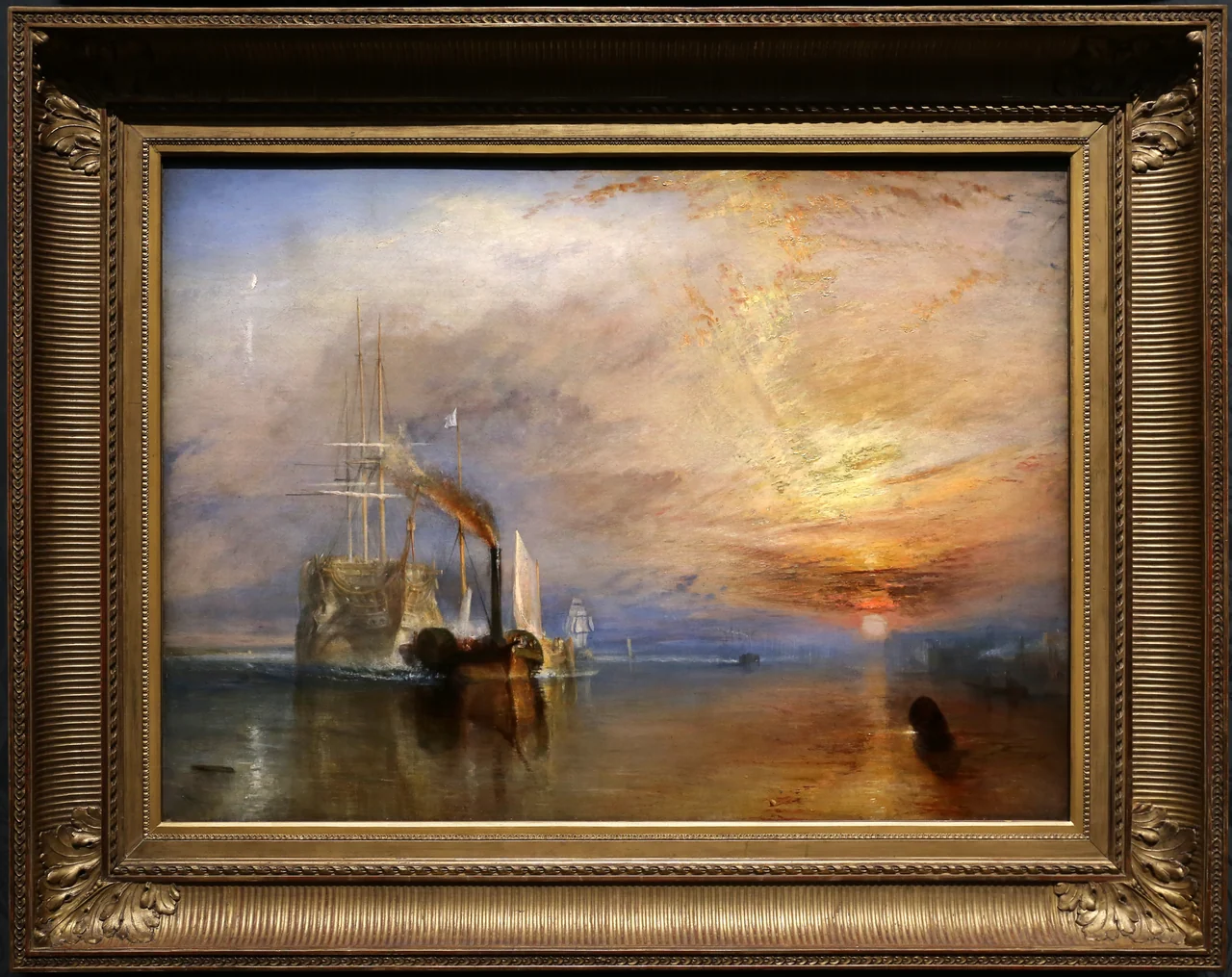
The dark tug is much smaller than the sailing ship, but its blunt shape and smoke draw attention immediately. Behind it, the taller vessel looks pale and almost insubstantial. Across the water, the setting sun supplies a second bright focus. The picture holds these areas apart rather than making the ship fill the whole frame.
Look at the reflections. Dark forms below the tug give it weight, while light breaks across the water on the right. The ship’s masts rise into a cooler area of sky; the sunset gathers warmth elsewhere. Even without knowing the naval story, the contrast between a heavy machine and a luminous older vessel is legible.
A tight crop of the ship loses that balance. A sunset-only detail may be beautiful, but it no longer explains the title. If you publish either detail, identify it as a crop and show or link the complete composition when the surrounding argument depends on it.
Our illustration includes the physical frame captured by the photographer. The frame is not an extra border Turner painted around the scene, and it is not a promise that a purchased reproduction will arrive framed. That distinction matters especially when this image appears beside a product or decorating suggestion.
An old painting does not license every download
Turner died in 1851, outside the ordinary UK and EU life-plus-seventy author terms. A current photograph remains a separate file question, particularly when it includes lighting, perspective and a frame.
The National Gallery’s licensing page separates open collection data from image files. Its stated image licence is CC BY-NC-ND 4.0, not the licence we use here. Do not transfer a permissive data label onto a photograph, or assume that an available download is automatically cleared for merchandise.
Someone may choose to request a museum-supplied file for a particular production. That is a separate route, with its own terms. This article does not claim that such a request has been made or approved on your behalf.
The CC BY photograph used here
The exact Commons description identifies Sailko, own work, photographed 1 March 2017, and a CC BY 3.0 release. It is not a copy of the National Gallery’s download with a new label pasted onto it.
CC BY 3.0 permits commercial reuse and adaptation when its conditions are followed. Preserve attribution and the licence link, and identify relevant changes. Here the photograph is reduced proportionally; its photographed frame remains visible. The credit does not imply that Sailko or the National Gallery endorses GeMarkt.
If you replace this photo with another view, check that view’s source anew. A similar thumbnail is not evidence that the same photographer made it, that the same licence applies or that no additional artwork appears at its edge.
Early engravings and the US evidence
There is better historical evidence than the painting’s date alone. The National Gallery’s scholarly catalogue records James Tibbits Willmore’s steel engraving, published by J. Hogarth in 1845, titled The Old Téméraire. It also explains a significant change: the tug’s mast was placed ahead of its funnel in that issue, then the plate was reworked towards Turner’s arrangement before publication in The Turner Gallery in 1851.
That is a documented publication history with different states, not merely an exhibition date. It also explains why a monochrome print found online might disagree with the oil painting while still being a genuine historical reproduction.
This guide has not independently inspected the issued copies and their complete authorisation history. It treats the catalogue as strong publication evidence, not as a substitute for a project-specific U.S. clearance opinion. A photograph’s Creative Commons licence cannot by itself settle underlying artwork rights in every territory.
The U.S. Copyright Office distinguishes display from publication. Showing the canvas in 1839 is not, by itself, proof that authorised copies were then distributed. The identified 1845 and 1851 editions are the useful leads to follow instead.
Choosing a file for a print or a page
For an article, the frame-inclusive view makes clear that this is a painting being encountered as an object. For a wall print, you may want a different, properly sourced file showing only the painted surface. Do not remove or relabel the frame without also updating the reproduction description.
Check the hulls, masts and sky at the intended output size. A file can have ample pixel dimensions yet contain glare, compression or aggressive sharpening. Our web image is an illustration, not a colour-certified print master or a supplier’s production specification.
Keep the distinction between a source photograph and a mockup. If you put the artwork into a new room image, say what is a visualisation. Neither an old master’s name nor a photograph’s open licence turns an imagined frame, paper finish or wall scale into a verified product feature.
Keep a useful credit
A workable credit records J. M. W. Turner, The Fighting Temeraire, 1839, National Gallery NG524; photograph by Sailko; CC BY 3.0; any changes, with links to the exact file and licence. Save those links with the working image rather than relying on a search result later.
The useful answer is therefore specific: ordinary author terms have expired, a named openly licensed photograph is available, and early engraving publication is documented with states that should not be confused. A blanket “all Turner images are free” would tell you less and could lead you to the wrong file. This is general information, not individual legal advice.
Editorial record
About this article
- Author
- Publisher
- GeMarkt
- Published
- Reviewed
- Internal source & rights check. Conducted by GeMarkt Research Review. This is an internal editorial check—not independent peer review.
- Source standard
- Rights guide source standardSeparates the underlying work from the source file, records the review date, and links the evidence used for the conclusion.
Found a claim that needs checking? Report a factual error.