GeMarkt Blog · Reference
Is Rain, Steam and Speed by J. M. W. Turner Public Domain?
Check Turner’s railway painting, Brandard’s different engraving and a licensed real photograph. The old canvas and every online file are not the same question.


The short answer
Turner’s original painting is outside the ordinary UK and EU author copyright terms. The real photograph shown here has its own CC BY 3.0 licence. Neither finding makes every museum download or modern railway poster unrestricted.
This guide concerns Rain, Steam, and Speed – The Great Western Railway, 1844, National Gallery NG538, checked on 12 October 2026. A nineteenth-century engraving is documented, but it differs from the canvas. Its publication history should not be confused with the painting’s exhibition or with the terms of a photograph taken today.
Identify the railway painting
The National Gallery’s object record gives oil on canvas, 91 × 121.8 cm, and the Turner Bequest, 1856. The subject is the Maidenhead Railway Bridge, designed by Isambard Kingdom Brunel and completed in 1838. The engine is heading west while our viewpoint looks east.
The picture is not a diagram of a locomotive or an engineering drawing of the bridge. Its railway structure drives diagonally through a landscape in which forms dissolve into weather. A reproduction that makes every field and building equally crisp changes a central feature of what we are looking at.
“Rain, Steam and Speed” is a convenient short title. Add Turner, 1844 and NG538 to a research record so that it cannot be confused with an engraving after the painting, a contemporary photograph of the bridge or a modern interpretation with the same name.
The Turner artist guide offers a broader introduction. Here the focus is the individual painting and the specific source you might use for a page, print or educational project.
The engine is clearer than the weather
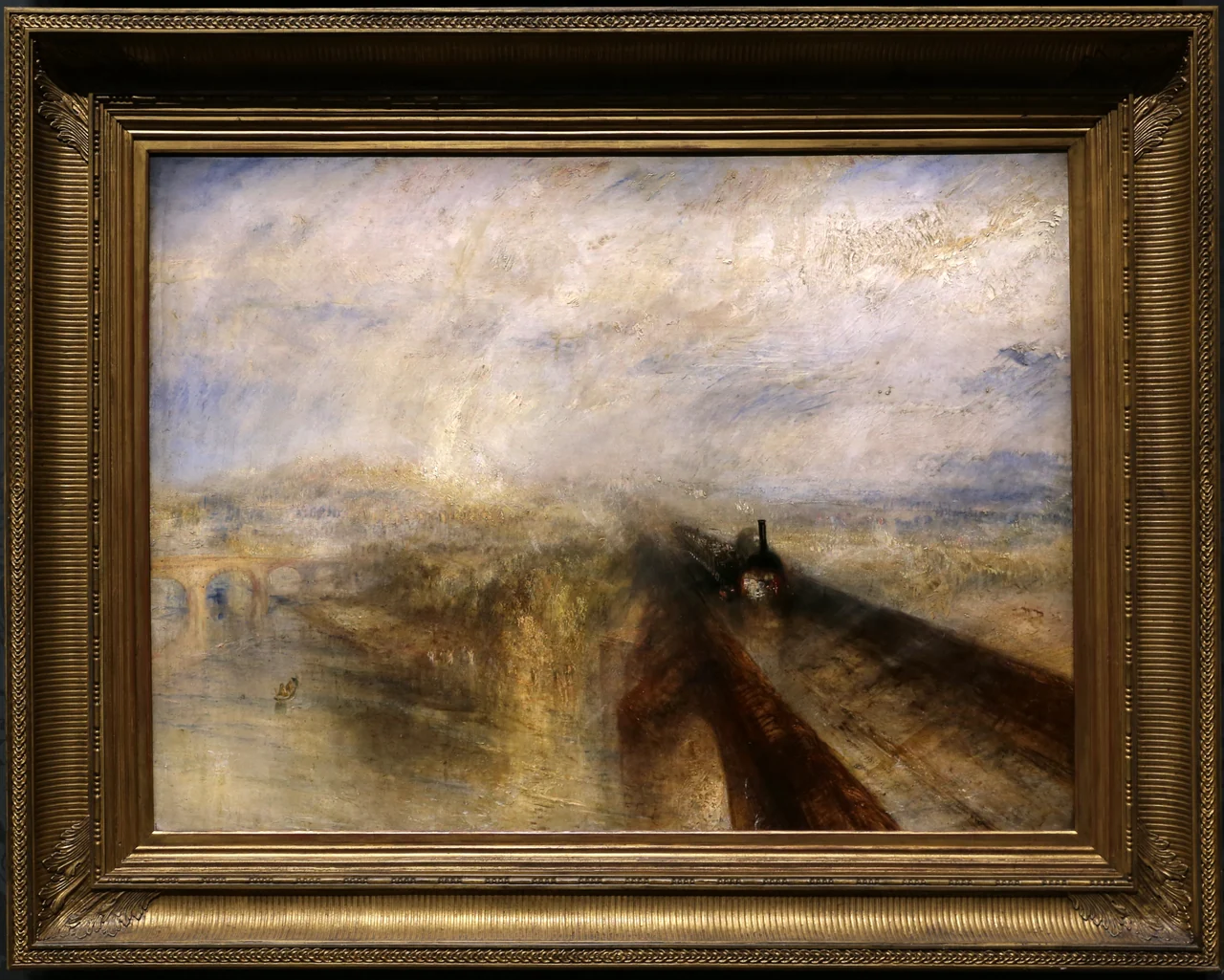
The engine is small compared with the whole canvas, yet it anchors the scene because it is dark and relatively definite. The bridge grows wider towards us, creating a route out of the mist. Large pale areas do not simply surround the train: they make its arrival feel abrupt.
At the left, another bridge and a little boat offer quieter forms. Above them, diagonal marks and thin changes of colour give the sky movement without turning it into a neat pattern of rain. Look at the difference between the firm railway edge and the broken tones around it before zooming into individual details.
This matters for image selection. A flat brown cast can hide the contrast between cooler sky and warmer ground. Strong sharpening can make the surface look gritty rather than atmospheric. An image described as “restored” or “enhanced” should explain what was changed, not suggest that a sharper result must be closer to Turner.
The gilt surround in this photograph is a physical frame. We retain it as part of the licensed photo and do not present it as part of the painted landscape. A decorative product photo using this view would need to make the supplied frame, if any, clear separately.
Why an engraving is not the painting
The National Gallery explains that a hare added to the track has become invisible as the paint grew transparent with age. It is visible in Robert Brandard’s 1859 engraving. We have not drawn the animal back into the painting or marked a speculative location on our photograph.
The scholarly catalogue describes Brandard clarifying indistinct forms, including the hare. It places his work in The Turner Gallery, a commissioned set of sixty plates issued between 1859 and 1861. These are useful publication facts, but the engraving is an interpretation in another medium, not a monochrome photograph of the canvas.
If an illustration shows a very distinct animal and more sharply resolved scenery, check whether you are looking at that print. Do not colourise it and label the result as an untouched scan of Turner’s oil painting. A caption such as “Robert Brandard, after J. M. W. Turner” preserves a distinction that matters both artistically and legally.
The British Museum’s related impression is described as a proof before letters. An individual proof is not the same object as a commercially issued book plate. Its existence helps identify the print, but should not silently stand in for the publication details of every impression.
Ordinary copyright and US publication
Turner died in 1851, long outside the ordinary author terms in the UK and EU. That does not make a new photograph or a new editorial text part of the same expired copyright.
For the United States, the published engraving is a meaningful historical lead. We have not independently completed the exact issued-copy and authorisation chain for a formal U.S. clearance. The museum catalogue is evidence of publication, not evidence that this article has examined the entire chain itself.
The U.S. duration statute distinguishes historical publication cases from works formerly unpublished. A creation or exhibition date is not a substitute for the applicable publication facts. Keep the 1844 canvas, the later engraved issue and the present photographic file as separate records.
Our photograph is not the museum download
The selected Commons file is Sailko’s own photograph, dated 1 March 2017, released under CC BY 3.0. The original file and its attribution were checked together. It is not a National Gallery image redistributed under an unrelated licence label.
The gallery’s website licensing page applies CC BY-NC-ND 4.0 to its image content, separately from more permissive data terms. Those restrictions are not erased by Turner’s death date. If you want the museum’s particular digital reproduction, assess that file and its terms directly.
The existence of both routes is not a contradiction. The same old canvas can appear in photographs supplied by different people under different conditions. “Which painting?” and “whose file?” are both necessary questions.
Reusing the image with its credit
CC BY 3.0 allows reuse, including commercial use, with attribution and the other licence conditions. Keep the photographer, exact source link and licence link visible; describe changes where appropriate. Our displayed derivative is proportionally reduced and retains the full photographed frame.
A useful credit reads: J. M. W. Turner, Rain, Steam, and Speed – The Great Western Railway, 1844, National Gallery NG538. Photograph by Sailko, CC BY 3.0; resized. Link the file and licence rather than crediting “Google Images.” Do not imply endorsement by the photographer or museum.
If another editor swaps in a cleaner-looking scan, the old credit may no longer apply. Store the source information beside the working file, and check the replacement before publication.
Choose the right reproduction for the job
For a railway-history article, the painting and an engraving may serve different arguments; label them accordingly. For a room print, evaluate a suitable full-resolution source at the actual output size. The web illustration here is not a promise of production quality at any requested dimensions.
For a narrow phone screen, a train-centred crop loses much of the left-hand river landscape. It may still be useful, but call it a detail. Extending the sky or reconstructing an invisible hare would create a changed image, not recover something established by this photograph.
The practical conclusion is specific: an expired ordinary author term, a documented historical print tradition and a named, openly licensed modern photograph. Keep those findings distinct and the picture becomes easier to use accurately. This is general information, not individual legal advice.
Editorial record
About this article
- Author
- Publisher
- GeMarkt
- Published
- Reviewed
- Internal source & rights check. Conducted by GeMarkt Research Review. This is an internal editorial check—not independent peer review.
- Source standard
- Rights guide source standardSeparates the underlying work from the source file, records the review date, and links the evidence used for the conclusion.
Found a claim that needs checking? Report a factual error.