GeMarkt Blog · Reference
Is Paris Street; Rainy Day by Caillebotte Public Domain?
The Art Institute marks its 1877 Caillebotte painting public domain. Find the exact open image and understand what that says about your own use.

The short answer
Yes for the identified Art Institute of Chicago object and its open image: the museum marks Paris Street; Rainy Day, 1877, accession 1964.336, public domain. Its open-access image offers a practical reuse route. That answer belongs to this painting and file, not to every photograph or commercial adaptation carrying the title.
There is also a limit worth stating immediately: this guide records the institution’s assessment but has not independently reconstructed the painting’s early authorised publication history under U.S. law. Caillebotte’s death date, the canvas’s date and its exhibition history are different pieces of evidence. None should silently stand in for all the others.
Start with the Chicago canvas
The Art Institute’s object record identifies an 1877 oil painting, measuring 212.2 × 276.2 cm. The accession number is 1964.336. It is a very large painting, not a small illustration of people carrying umbrellas.
The museum places the scene at a Paris intersection near the artist’s home and relates its sharp cropping and unusual viewpoint to photography. Those are useful points of context, but the picture is a composed painting. Its apparent instant of street life does not mean that Caillebotte simply reproduced one identified camera exposure.
The title is also written Paris Street, Rainy Day, Paris Street in Rainy Weather or, in French, Rue de Paris, temps de pluie. Punctuation alone is not a reliable way to distinguish records. Match the museum, accession, dimensions and full image.
Our Caillebotte artist guide introduces other subjects. A rights decision for this Chicago image should not be extended to all the interiors, rowers or street paintings discussed there.
The couple, the lamp and the open street
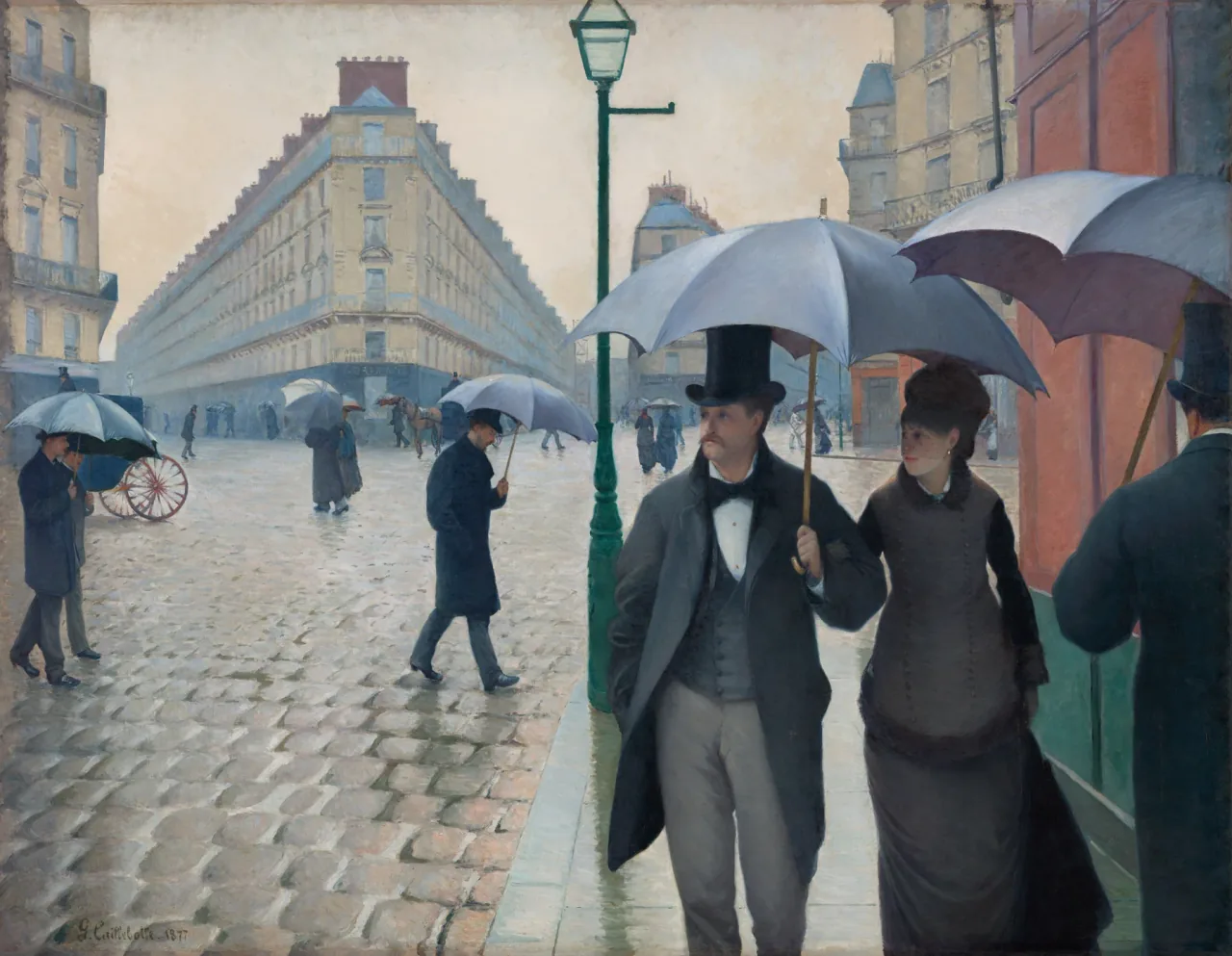
The foreground couple seem close enough that we might have to step aside. At the right edge, another man is already cut off by the picture. Across the street, figures become smaller and leave much wider gaps between them. That contrast makes the space feel both crowded and strangely open.
The lamp post divides the view without placing everything in neat halves. Its dark upright fixes the eye while the paving, kerb and long building fronts pull it into depth. Umbrellas repeat a rounded shape at several scales, connecting people who are otherwise moving in different directions.
These observations help assess a reproduction. A portrait-format crop around the couple may look attractive, but it removes the broad street that gives their proximity its force. A very small preview can also turn the wet paving into an even grey surface, losing the uneven reflections visible in a better file.
When you use the painting to discuss modern city life, include the whole view before isolating a face or umbrella. The edges are not accidental empty space waiting to be removed.
The museum file and its permission
The museum’s current public object data identifies this exact accession and returns is_public_domain: true. The approved image used here retains the Art Institute’s Public Domain / CC0 attribution. It is not a photograph lifted from a third-party print listing.
CC0 is intended to remove copyright restrictions within the rights held by the party applying it. It is not a statement that a museum guarantees every possible use in every jurisdiction. It does not authorise a claim of museum sponsorship or let someone describe a newly altered design as an untouched museum image.
The museum’s API documentation also warns that its image service can contain images that are not public domain. The fact that a picture loads from a museum server is therefore insufficient. The status of this object, rather than the reputation of the domain name, is the useful check.
Keep the accession and source link even when an open licence does not demand a formal attribution. They let the next person distinguish this download from a similarly named study, a visitor’s installation photograph or an image with a seller’s watermark.
Why 1877 is not the whole legal answer
Caillebotte died in 1894. His ordinary economic term has expired under the standard French life-plus-70 rule in Article L123-1. That is a statement about the underlying painting in that framework, separate from the rights in a particular later file.
For U.S. analysis, the Copyright Office’s guidance for visual artists distinguishes public display from publication. An authorised sale or distribution can be relevant; an exhibition alone is not enough to establish the answer.
This article does not audit which early events qualify for this canvas under the applicable historical rules. Its practical conclusion rests on the museum’s specific public-domain identification and open image, not an invented first-publication date. A project requiring an independent legal opinion should retain that distinction when handing the material to an adviser.
A study is not a smaller download
A search for this painting can lead to preparatory work. That may be valuable evidence of how Caillebotte planned the scene, but a study is a separate artwork. Its visible details, medium, owner and file rights may differ from those of the finished canvas.
Before making a comparison, check the people closest to the viewer, the treatment of the buildings and the location of the lamp. Ask whether differences come from a separate work or from a crop, faded reproduction or colour adjustment of the same work.
A download’s pixel dimensions are a third matter. The same finished painting may be offered in several digital sizes. Choosing a smaller download does not turn it into a study; choosing a study does not make it an authorised “low-resolution version” of the finished painting.
Framing the picture without changing the street
The museum’s canvas dimensions give a width-to-height ratio of about 1.30:1. A common 4:3 frame is close but not identical. At 40 cm wide, the complete image would be about 30.7 cm high; a border or mount can accommodate the difference without stretching anyone.
For a print listing, show the actual crop if you decide to fill a frame edge to edge. The customer should be able to see whether the right-hand passer-by, the foreground paving or part of the architecture is missing.
For an editorial layout, let the full painting appear wide enough to read. Place any enlarged detail beside the paragraph that explains it. A decorative thumbnail alone will not show why the distance between the couple and the other pedestrians matters.
What to save with your image
Retain the original download, the object-page URL, 1964.336, the stated public-domain status and the date you checked it. Record any cropping or colour changes separately. This is enough to make the image traceable without burying a reader in technical production notes.
A plain credit is useful: Gustave Caillebotte, Paris Street; Rainy Day, 1877; Art Institute of Chicago, 1964.336; Public Domain / CC0. Do not add “museum-approved print” unless you have a separate agreement supporting that claim.
The best starting point is the museum’s exact open file. Use it with the full scene in mind, and keep the institution’s rights assessment distinct from a legal publication history that this guide has not independently proved.
Editorial record
About this article
- Author
- Publisher
- GeMarkt
- Published
- Reviewed
- Internal source & rights check. Conducted by GeMarkt Research Review. This is an internal editorial check—not independent peer review.
- Source standard
- Rights guide source standardSeparates the underlying work from the source file, records the review date, and links the evidence used for the conclusion.
Found a claim that needs checking? Report a factual error.