GeMarkt Blog · Reference
Is Renoir’s Luncheon of the Boating Party Public Domain?
Identify Renoir’s Phillips Collection painting, separate its copyright from image permissions, and understand the Commons reproduction used here.


The short answer
The underlying Renoir painting is beyond its ordinary French and UK economic copyright term; the particular Commons reproduction used here is marked public domain. The Phillips Collection nevertheless operates a separate licensing service for images it supplies. These are different statements, not a reason to ignore one of them.
The object is Luncheon of the Boating Party, 1880–81, Phillips Collection number 1637. As of 12 October 2026, this guide attributes the Commons file assessment but does not claim an independently completed U.S. publication analysis. Check the country, the work and the exact file before treating “public domain” as permission for a proposed use.
The painting in Washington
The Phillips Collection record identifies an oil painting measuring 130.2 × 175.6 cm, acquired in 1923. The French title is Le Déjeuner des canotiers. A short filename saying “Renoir lunch” is not an adequate identifier: Renoir painted other restaurant and boating subjects.
The museum identifies the dog-holding woman at the lower left as Aline Charigot, later Renoir’s wife, and the man sitting backwards on his chair at right as the painter Gustave Caillebotte. Those two figures are useful anchors when comparing reproductions. Do not assume that every person in the scene has an equally secure identification simply because these familiar names are established.
The painting is more than a row of portraits. Its arrangement gives individual people different degrees of attention: one looks across the table, another drinks, others lean into separate conversations. A copy cropped to a famous face may be perfectly legible as a detail but cannot stand for that larger construction.
A table that joins several conversations
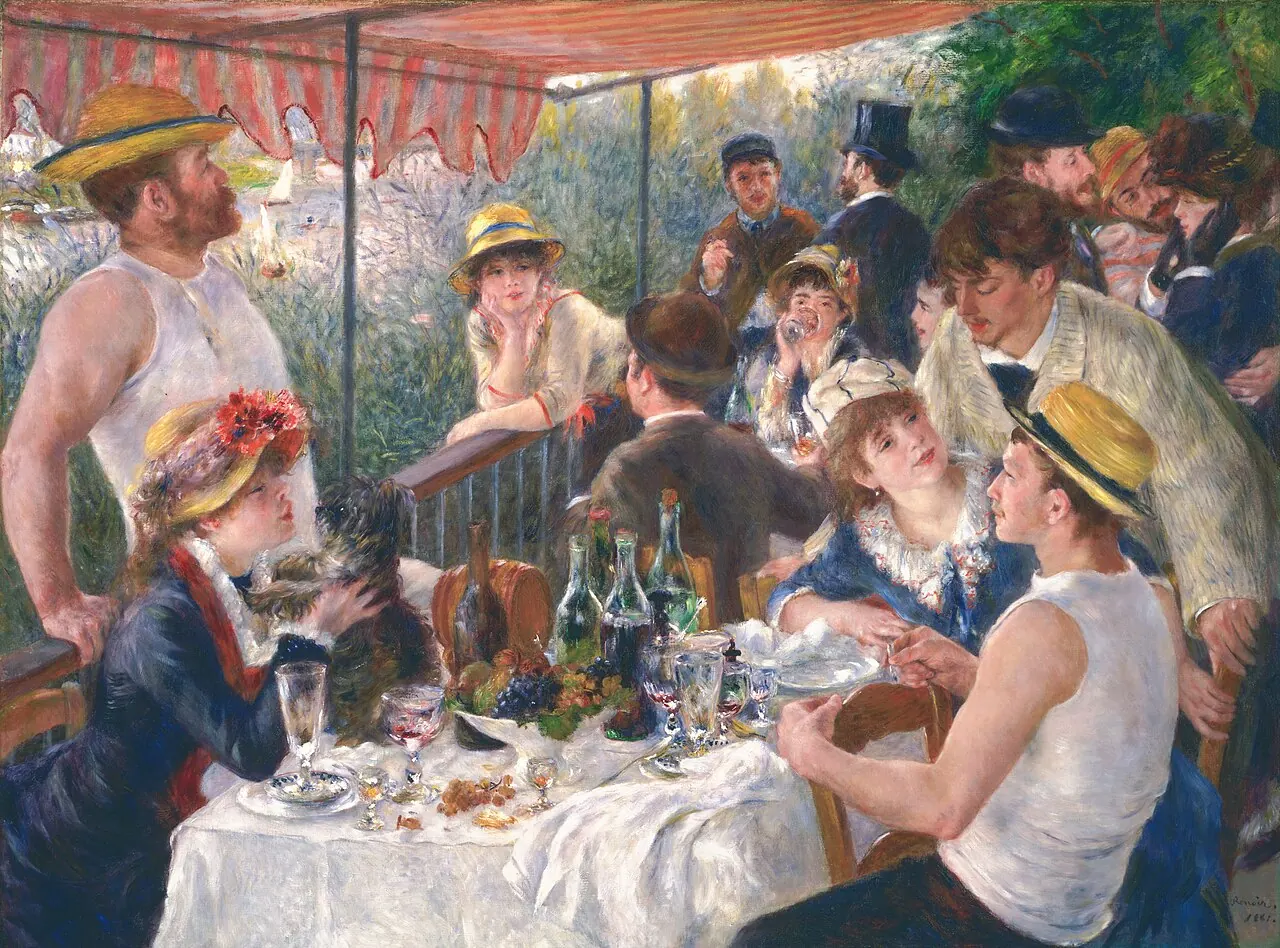
Start with the white tablecloth. It spreads across the foreground like a bright platform for glasses, bottles and fruit, then meets bodies that turn in different directions. The darker railing takes the eye diagonally towards the middle distance. Above, the awning compresses the space into something more intimate than an open landscape.
The exposed arms at opposite sides form another connection. Hats repeat rounded shapes, but the faces beneath them do not all look towards a single centre. This gives the gathering its convincing disorder: the picture feels sociable without arranging everyone for a formal group photograph.
At a small size, the glassware can vanish into the cloth and the people at the upper right can merge into one dark cluster. Before using a file in a layout, inspect those areas rather than judging quality from the brightness of the awning alone. If the details dissolve, give the image more space or choose a better source instead of inventing sharpness.
Which download is being used
The image above is derived from the specific Google Art Project reproduction hosted by Wikimedia Commons. That page identifies the Phillips painting, gives object number 1637 and applies PD-Art / Public Domain Mark 1.0. The view includes the full supplied composition, not a separately uploaded portrait crop.
Its file history contains different resolutions and an earlier upload described as slightly cropped. This is a useful warning: even a stable page title can contain a changing file. Keep the version you actually downloaded with the source record rather than assuming that someone following the link years later will receive identical pixels.
The mark reports the provider’s public-domain assessment. It does not establish that the Phillips has granted you a bespoke reproduction agreement, and it is not a promise that national rules about photographs are identical. For the broader distinction, see Public Domain Is Not a Free-for-All.
The Phillips image service
The museum’s current image-licensing page describes a request-based service with fees and a reproduction agreement. It asks about the intended publication or other use; non-editorial or commercial uses of a Phillips-supplied image require approval under that service. Those terms should remain attached to files obtained through it.
That does not, by itself, prove continuing copyright in Renoir’s original composition. It describes a supply and permission route. Conversely, finding a public-domain-labelled reproduction elsewhere does not entitle someone to download a different museum file and claim that the Commons notice covers it.
Consider two publishers. One wants a traceable illustration for an online discussion and selects the identified Commons reproduction. Another needs a museum-supplied production file and a written agreement for a large print run. Their source choices and paperwork need not be identical even though the historical picture is the same.
Keep the source credit accurate in either case. “Courtesy of the Phillips Collection” should not be invented to make an independently sourced image sound officially supplied.
Why an American collection does not settle U.S. copyright
Renoir died in 1919. The ordinary French life-plus-70 economic term under Article L123-1 has elapsed, as has the standard UK artistic-work term. That is not the same calculation as the rules governing an older work in the United States.
The Copyright Office’s duration guidance distinguishes older published works from works remaining unpublished into the modern statutory system. The painting’s creation in 1880–81 and acquisition in 1923 are not substitute publication dates. An authorised sale can matter, but historical events must be assessed under the applicable rules.
The Commons page provides a pre-1931 publication or registration statement. An independently examined chain establishing the first qualifying publication is not supplied here. Neither the fact that the painting hangs in Washington nor its popularity fills that gap. For a use requiring a definite U.S. legal opinion, keep the unresolved branch explicit rather than silently borrowing a conclusion from the museum’s location.
A detail is not the whole party
A crop around Aline and the dog changes the balance: it becomes a tender encounter, with much less sense of a shared lunch. A crop around Caillebotte makes his turned body the main subject. Both may support a focused discussion if the caption says “detail”. Neither should be presented as the entire canvas.
For a full reproduction, preserve the table’s front edge and the awning. At 50 cm wide, the museum’s recorded proportions give an image about 37.1 cm high. Borders and frames are additional; this calculation does not describe the dimensions of any particular product.
A strong colour cast also changes the social space. Increasing the reds may make the awning more dominant, while crushed shadows hide the people behind the seated pair. Compare a proposed adjustment with the source, and describe a deliberate reinterpretation as an adaptation rather than an improved original.
Using the image with a clear caption
A useful caption identifies Renoir, the title, 1880–81, the Phillips Collection and object 1637, followed by the actual reproduction source. Save the download date and any alterations in the working record. That modest amount of information makes later corrections possible without turning the reader-facing page into an archive form.
The answer is therefore yes within the stated French/UK term and Commons-file assessment, not an unrestricted claim about every image or territory. Choose the reproduction first, retain its terms and keep its evidence separate from the painting’s history. This is general research information, not legal advice for a particular commercial project.
Editorial record
About this article
- Author
- Publisher
- GeMarkt
- Published
- Reviewed
- Internal source & rights check. Conducted by GeMarkt Research Review. This is an internal editorial check—not independent peer review.
- Source standard
- Rights guide source standardSeparates the underlying work from the source file, records the review date, and links the evidence used for the conclusion.
Found a claim that needs checking? Report a factual error.