GeMarkt Blog · Reference
Is Jeanne Hébuterne with Hat by Modigliani Public Domain?
Which hat portrait? A check of Modigliani’s 1917 panel, its early catalogue references and the exact Commons reproduction—not every portrait of Jeanne.


The short answer
The ordinary life-plus-70-year copyright term for Modigliani’s painting has expired. The exact reproduction shown here is marked public domain on Wikimedia Commons, but that mark is not a fresh licence from Sotheby’s or a completed worldwide clearance. The U.S. publication evidence needs a little more care than the painting date alone can supply.
This guide concerns Jeanne Hébuterne (au chapeau), the 1917 oil-on-panel portrait measuring 67 × 51.5 cm, catalogued at Sotheby’s New York on 2 November 2010, lot 14. It is the portrait with the close-fitting dark hat and blue necklace below. The check is current to 12 October 2026.
A hat is not a unique identifier
Modigliani painted Jeanne more than once, and English titles are often shortened. “Jeanne Hébuterne with Hat” can therefore lead a reader to a different composition, date or support without any obvious warning in a search result.
The Sotheby’s record identifies this work as oil on panel, with the signature at the lower right. It references Ceroni’s 1970 catalogue, number 174. Those particulars are more reliable identifiers than a translated title by itself.
A useful counterexample is Christie’s separate 1919 Jeanne Hébuterne (Au chapeau): that work is an oil on canvas measuring 92 × 54 cm. The sitter and part of the title match, but the object does not. Its provenance and reproductions cannot be silently borrowed to answer a question about our panel.
This page does not assign the selected work a present museum home. The auction record provides an object history, not evidence that it now belongs to a particular public collection.
Look for the necklace and the panel
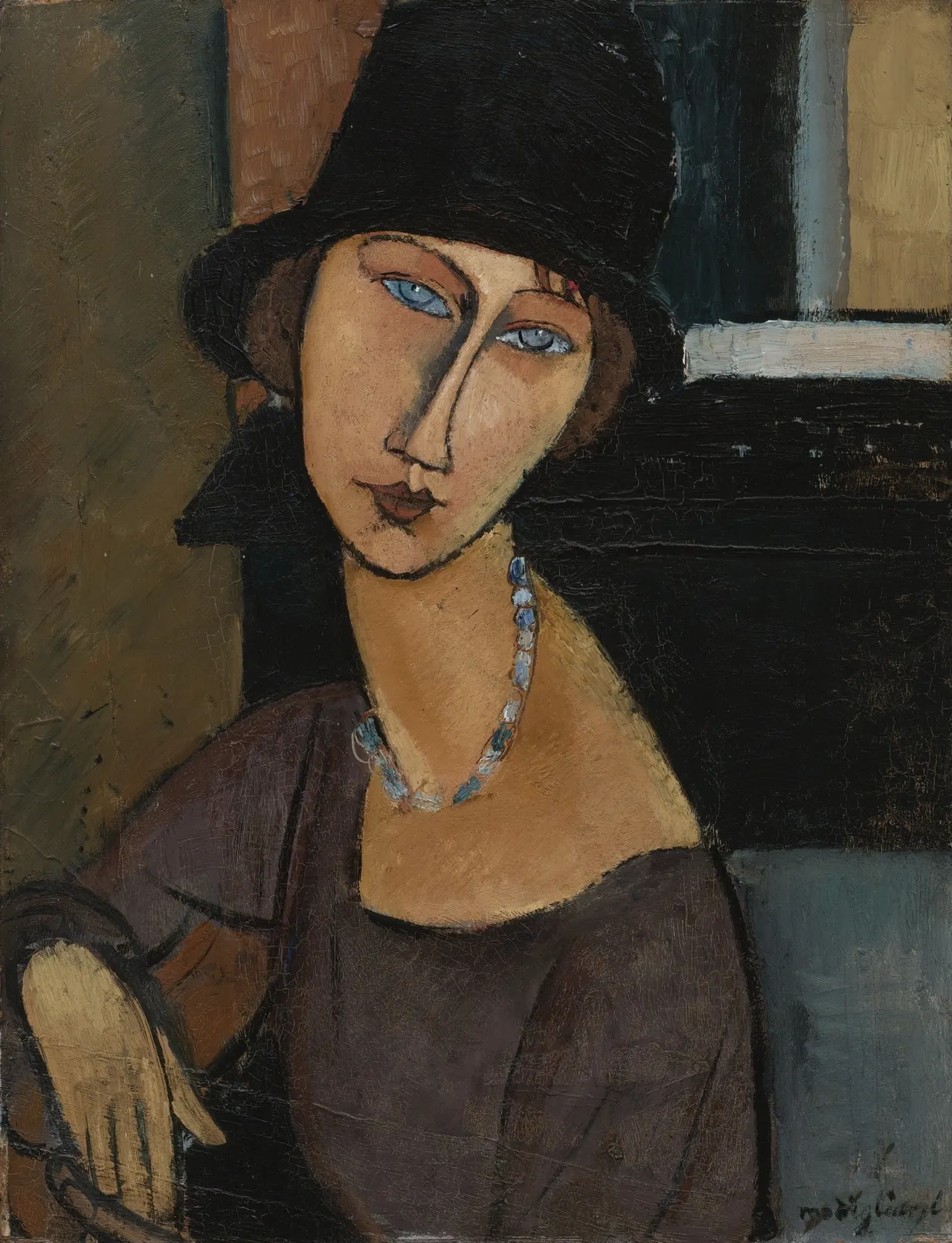
The blue eyes and necklace create small, sharp accents against the dark hat and dress. The head leans to one side, but the background is organised into more upright blocks. Keeping both in view makes the tilt readable without treating it as an isolated decorative gesture.
The hand is near the lower left edge. At the opposite corner, the signature helps confirm that the reproduction has not been reversed. Neither should be removed casually when comparing an online file with a catalogue illustration.
The face is not uniformly smooth. Changes of paint direction remain visible across the forehead and cheeks, while fine cracking is apparent in darker areas. A reproduction which erases every irregularity may look superficially polished but offers less evidence of the painted surface. That is an observation about this photograph, not a conservation diagnosis.
The close-fitting hat matters too. A search result showing a wide, sweeping brim should send you back to the object record. Similar colour or the same sitter does not make it a replacement file for this guide.
Where the author term has ended
Modigliani died in 1920. The ordinary seventy-year term after the author’s death has elapsed under the UK’s published duration guidance. Under the standard calendar-year calculation in French article L123-1, that period reaches the end of 1990.
Neither conclusion relies on the person in the portrait being Jeanne, or on the work having changed owners. The relevant author here is the painter. Ownership of the panel and authorship of the artistic work are different facts.
France’s continuing moral-rights provision is another reason to avoid saying “no rights of any kind remain”. A clear attribution and an honest description of alterations are sound editorial practice even where an ordinary exploitation term is over.
What the early catalogues can tell us
The Sotheby’s bibliography points to an illustration in André Salmon’s 1926 Modigliani, sa vie et son oeuvre, plate 3, and an illustrated entry in the 1929 De Hauke & Co. New York exhibition catalogue, number 26. These are specific research leads for this portrait, not dates guessed from its style.
We have verified that the auction record lists those references; we have not inspected those original publications and their distribution or authorisation history. The distinction matters. A bibliography can tell a researcher exactly where to look without itself completing the legal conclusion.
The U.S. Copyright Office’s explanation says public display alone is not publication; an authorised sale or distribution can be relevant. Sections 303 and 304 also distinguish the treatment of older published and previously unpublished works. The 1917 creation date is not a replacement for that analysis.
For a use requiring a firm independent U.S. answer, examine those early illustrated sources and the applicable publication facts. This guide retains that step as unresolved instead of treating a promising citation as a document already checked.
The exact file we use
Our image comes from the Commons record linked here. Its current 1,532 × 2,000-pixel original was uploaded on 25 April 2016, identifying the same Sotheby’s lot as its source. The object dimensions, panel support and composition agree with that record.

Commons applies PD-Art and the Public Domain Mark, including a U.S. pre-1931 publication assessment. We report that as the repository’s assessment, not as an independently reconstructed publication chain or a photographic CC0 waiver by the auction house.
The Public Domain Mark identifies a status; it does not create permission where copyright still exists. Its explanation also notes that rights can differ by jurisdiction. The source link is consequently part of the useful answer, not an optional decoration beneath it.
A reproduction is not the whole auction page
A flat reproduction of an old painting is different from a page combining that reproduction with a modern essay, condition report, layout and branding. This guide uses the documented Commons reproduction. It does not grant permission to copy an auction catalogue wholesale.
Likewise, a photograph showing a painting in a furnished room may contain choices and subject matter absent from a straight-on reproduction. Finding our panel within that room does not make the two files interchangeable. Check the precise file rather than the most familiar object inside it.
Keep the uncropped source beside any edited working copy. A later editor should be able to see whether a tight face crop was intentional, whether the background was removed, and whether the colour has been changed. That practical record prevents an altered design from gradually acquiring the caption of the untouched painting.
Using the portrait with a clear caption
For this example, a useful caption includes Modigliani; Jeanne Hébuterne (au chapeau); 1917; oil on panel; 67 × 51.5 cm, plus the linked reproduction source. An auction identifier can be helpful where there is no verified current museum accession.
Do not make the sitter’s expression carry an unsupported biographical story. The tilted head and blue accents are there to discuss; a precise state of mind is not visible evidence. A brief, accurate caption can leave room for looking without filling the gaps with certainty.
The result is a qualified answer: the painter’s ordinary term has expired, an exact public-domain-marked reproduction is available, and the early U.S. publication trail remains a documented research question. That answer belongs to this panel, not to every hat portrait of Jeanne.
Editorial record
About this article
- Author
- Publisher
- GeMarkt
- Published
- Reviewed
- Internal source & rights check. Conducted by GeMarkt Research Review. This is an internal editorial check—not independent peer review.
- Source standard
- Rights guide source standardSeparates the underlying work from the source file, records the review date, and links the evidence used for the conclusion.
Found a claim that needs checking? Report a factual error.