GeMarkt Blog · Reference
Is Danaë by Gustav Klimt Public Domain?
Klimt’s 1907–08 Danaë, a documented 1918 printed plate and the exact Yorck Project image: how the painting’s rights differ from a modern photograph.


The short answer
Klimt’s Danaë is beyond his ordinary Austrian author term, and a museum catalogue identifies a reproduction published in 1918. Those facts support a public-domain assessment of the historical work. They do not turn every modern photograph of this privately owned painting into a free-to-use file.
This check concerns Gustav Klimt’s Danaë, 1907–08, with the curled red-haired figure, purple fabric and shower of gold. It is not Titian’s, Rembrandt’s or another artist’s treatment of the same myth. The exact image shown below is a Yorck Project reproduction on Commons. Its source assessment and its limitations are described separately, as of 12 October 2026.
Which Danaë this means
The Klimt Foundation’s research account dates the painting 1907/08 and identifies it as being in a private collection. It records its first presentation at the Kunstschau Wien in 1908 and purchase by Eduard Ast. Neither a historical owner nor a temporary exhibition venue should be silently converted into a claim about where the painting can be visited today.
The familiar title belongs to a mythological subject. Klimt represents Zeus through the stream of gold rather than a standing male figure. That helps identify this particular image, but it does not justify describing the painting as a portrait of a named woman or inventing a sitter’s thoughts.
For a source record, keep artist, title and date together. “Danaë public domain” is too broad a search to settle a file’s identity: it can return paintings, preparatory drawings, later prints and contemporary reinterpretations. A print after Klimt should identify itself as a reproduction even when its title is shortened in a catalogue.
Recognising the composition
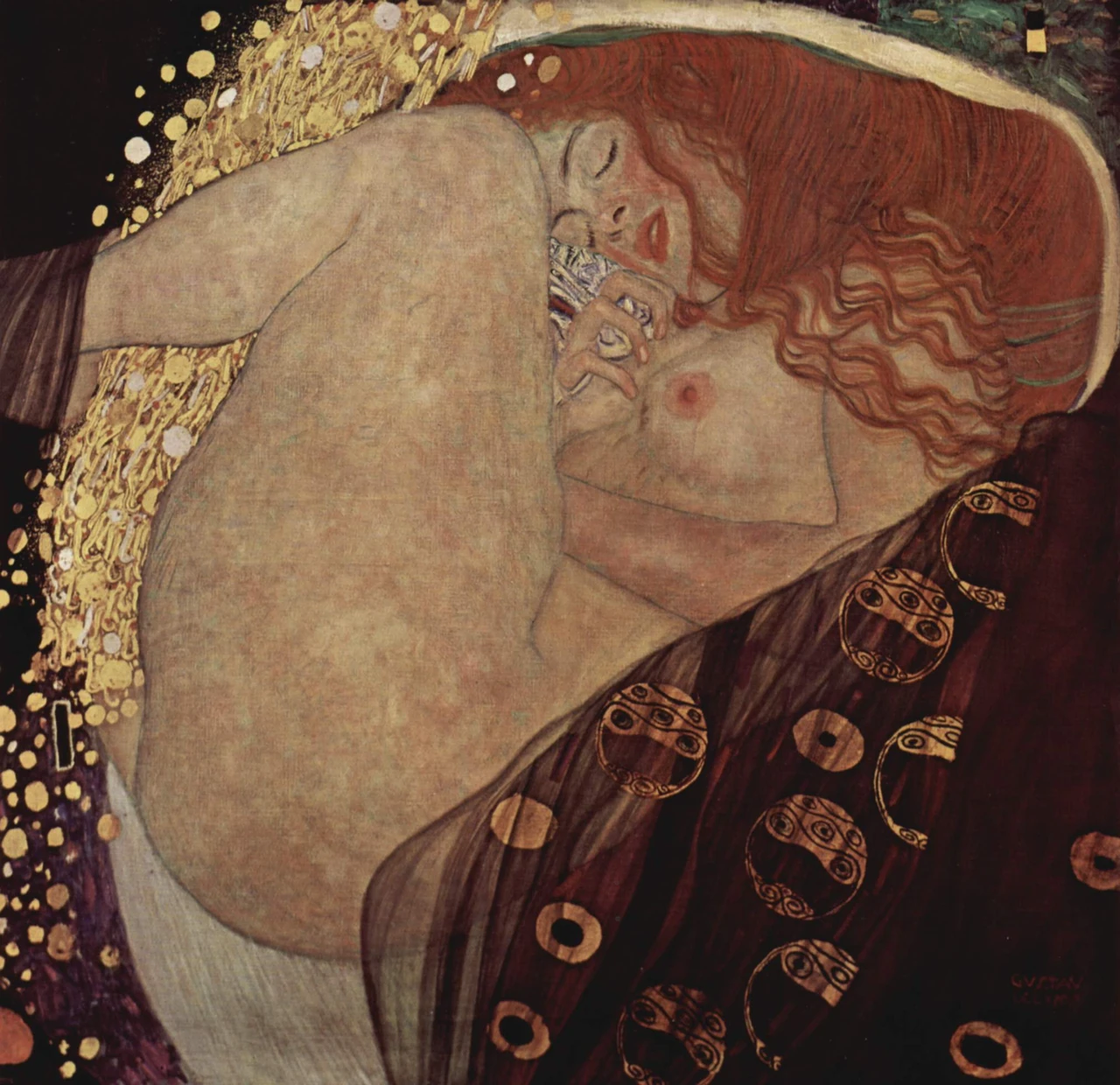
The body is folded rather than stretched across a broad landscape. The large bent leg occupies much of the left half, while the head and red hair curve around the upper right. The fabric repeats rounded shapes, but its dark, patterned surface is very different from the broad areas of skin. The result is a tightly packed image whose rhythm depends on the whole arrangement.
Notice how the gold runs close to the left boundary and the signature lies towards the lower right. An automatic square or portrait crop can cut these areas before it appears to damage the central figure. Preview the entire frame before deciding that a shorter crop is harmless.
The picture’s warmth should not be mistaken for a technical colour reference. This is one reproduction, not a measurement taken from the painting under controlled lighting. Increasing saturation until the gold looks brighter might make a striking thumbnail while moving further from the source. Keep the unedited source alongside any presentation version so the changes remain traceable.
A painting and a published plate
There is a useful dated object behind the rights discussion. The MAK catalogue records Danae nach Gustav Klimt, Tafel 32, inventory BI 19150-36, from Das Werk von Gustav Klimt. It identifies Kunstverlag Hugo Heller & Cie, Vienna, 1918, as publisher, and the technique as collotype on paper.
The record explicitly connects the plate to the original canvas and its historical owner, Eduard Ast. It gives separate dimensions for the sheet and printed image. Those details matter because a catalogue date of 1918 belongs to this issued reproduction, not to the moment Klimt painted the canvas.
This is stronger publication evidence than assuming that everyone at the 1908 exhibition received a printed copy. The MAK’s object is a real historical edition. Its modern photograph is a third thing, with its own source conditions; no MAK image is reproduced in this article.
The Yorck Project image is not evidence that this download depicts the MAK’s physical plate. A later reproduction may come from another photograph or printing. Keep the historical-publication reference and the downloaded-file reference distinct rather than merging them into a plausible but unverified chain.
What the dates establish
Klimt died in 1918. Austria’s sections 60 and 64 provide the ordinary life-plus-70-year term and the calendar-year calculation. That calculation puts the end of his painting’s ordinary author term after 1988. It does not determine all rights in a later photograph or edition.
For the United States, the 1918 plate is relevant evidence of publication, but an exhibition date alone is not. The U.S. Copyright Office distinguishes display from qualifying distribution; an authorised sale of an original can also matter. The historical rules applicable to the event must still be considered.
Under the U.S. duration provisions, a qualifying 1918 publication is beyond a 95-year term. This guide has not reconstructed the publisher’s complete authorisation records or every possible earlier publication. The identified plate supports the assessment; it is not a guarantee replacing a project-specific legal review.
What the Yorck Project file does and does not prove
The exact Commons file identifies The Yorck Project’s 2002 DVD-ROM collection as its source. Its public-domain statement distinguishes individual reproductions from copyright in the compilation. We use one image, not the compilation’s text, arrangement or complete database.
The page also carries a notice requesting a U.S. public-domain tag. That gap should not disappear when the picture is downloaded. The separate MAK plate record supplies useful historical evidence, but the Commons page itself is not a completed U.S. legal opinion. Its collection field names the Leopold Museum; the more specific Klimt Foundation account identifies a private collection, which is the description used here.
The Public Domain Mark is an assessment, not a new licence or a promise that every use in every country is unrestricted. A recent photograph from a private collection, foundation or publisher must be checked on its own terms. The familiar composition alone does not carry the earlier file’s source status across to that photograph.
Choose the right image for the job
Use this reproduction to identify and discuss the work, not as proof of how a newly made print will look. For a physical product, inspect the actual source at the intended output size and request a sample where appropriate. A clear online preview is not a substitute for sufficient image detail or an accurate description of the material being supplied.
Keep the reproduction’s existing proportions unless you are deliberately creating a labelled detail. Do not stretch it to match a remembered canvas measurement: catalogue measurements, photographed edges and scans can differ. Reconstructing missing borders with generated content would create a new image that should not be presented as an unchanged Klimt reproduction.
If you commission a new photograph, record the photographer’s permission separately. Owning a print, buying a download and receiving commercial reproduction rights are three different transactions. A receipt that names only the first does not prove the other two.
Credit the painting without inventing permission
A useful credit identifies Gustav Klimt, Danaë, 1907–08, then names the actual reproduction source. Do not add “courtesy of” a museum that did not supply that file, or suggest that a private owner has approved your edition. If you use the MAK plate as the image instead, describe it as the 1918 printed reproduction and obtain the appropriate file permission.
Our Klimt artist guide explains the wider work-by-work approach. Here the conclusion is narrower and more useful than “all Klimt is free”: the painting has an expired ordinary author term and an identified early publication record; the digital image and the intended use still have to match the evidence.
Editorial record
About this article
- Author
- Publisher
- GeMarkt
- Published
- Reviewed
- Internal source & rights check. Conducted by GeMarkt Research Review. This is an internal editorial check—not independent peer review.
- Source standard
- Rights guide source standardSeparates the underlying work from the source file, records the review date, and links the evidence used for the conclusion.
Found a claim that needs checking? Report a factual error.