GeMarkt Blog · Reference
Is Renoir’s Bal du moulin de la Galette Public Domain?
Renoir’s painting, its museum photograph and a Commons download need separate checks. Identify the Orsay canvas and choose a traceable reproduction.


The short answer
Renoir’s ordinary economic copyright term has expired in France and the UK, and the specific Google Art Project reproduction shown here carries a Wikimedia Commons public-domain designation. That does not make every downloadable photograph of Bal du moulin de la Galette freely reusable everywhere.
This answer concerns the large 1876 Musée d’Orsay painting, RF 2739, checked as of 12 October 2026. The Commons statement is attributed to its publisher; an independent historical U.S. publication determination remains unresolved here. A museum photograph and a seller’s edited file need their own assessment.
Identify the Orsay painting
The Musée d’Orsay record identifies an oil painting measuring 131.5 × 176.5 cm, accepted through Gustave Caillebotte’s bequest in 1896. The museum records its appearance at the Impressionist exhibition of 1877. The work depicts the lively outdoor dance garden in Montmartre, with some of Renoir’s friends among the crowd.
Use RF 2739 as the accession. The number 497, which appears in the museum’s web address and in some copied image metadata, is a website record identifier rather than the painting’s inventory number. That distinction prevents a small cataloguing error from following an image through several websites.
The English title Dance at Le Moulin de la Galette refers to this same composition. However, a similar title by another painter, a detail extracted from this picture or a different Renoir version should not inherit this record automatically. Compare the entire view, not just the seated figures most often used on book covers.
Light that connects the crowd
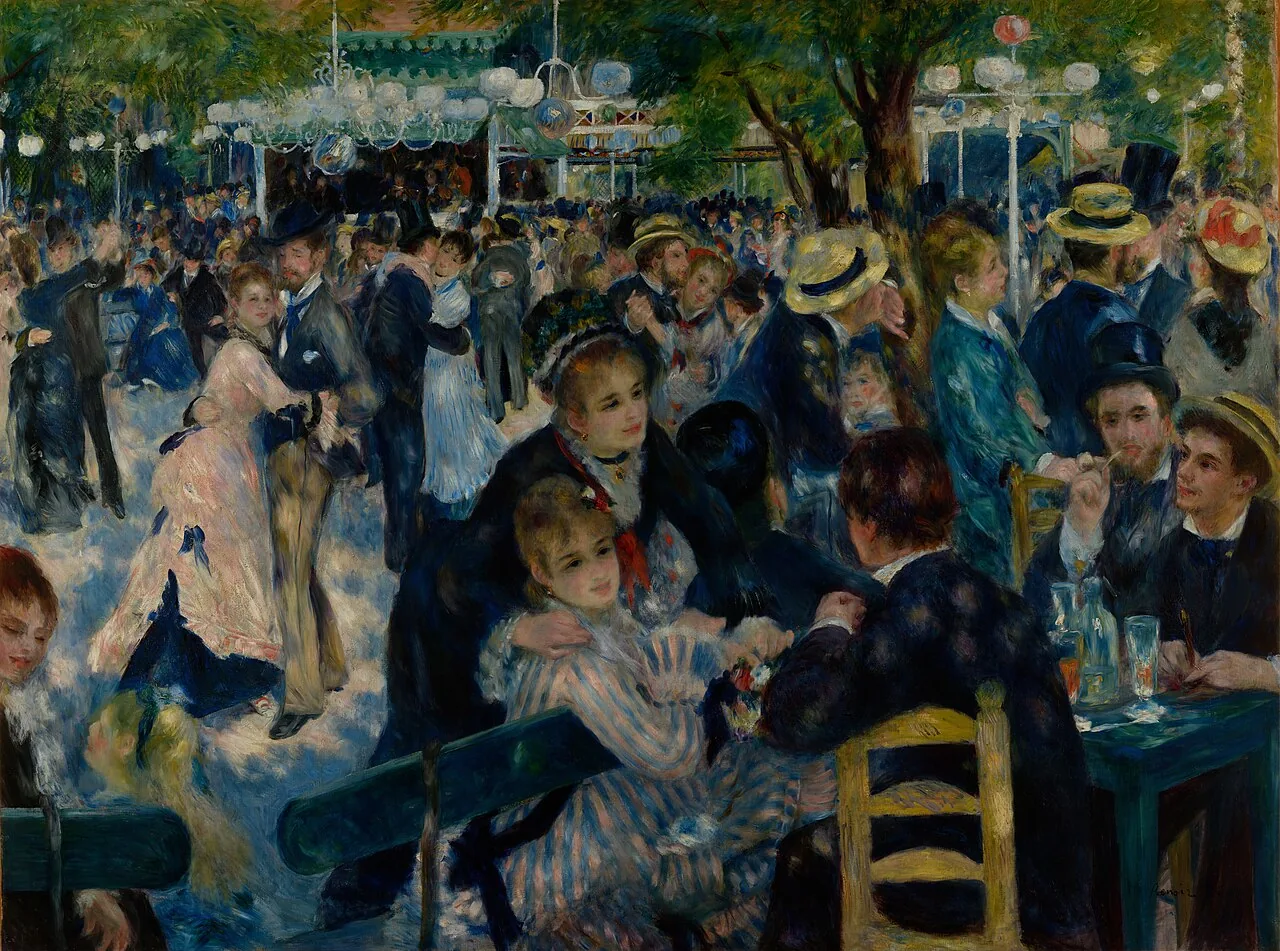
The picture gives us several distances at once. A chair back almost meets the bottom edge; behind it, the seated group appears close enough to join. Farther away, dancers overlap until individual gestures become difficult to separate. The trees and hanging lights hold these groups inside one shared setting.
Pale marks cross dresses, sleeves, faces and the ground. They do not behave like a clean spotlight isolating a single performer. Instead, repeated patches of brightness connect people who are turned towards different partners and conversations. The lively surface belongs to the subject: a gathering in which attention continually shifts.
This matters when choosing an image. Strong sharpening can make the small strokes look like brittle outlines. Excessive contrast can close the dark suits into black blocks and separate the figures from the surrounding air. A convincing reproduction preserves enough variation to let your eye move between the crowd and the nearest faces.
The file shown here
The displayed image comes from the exact Commons Google Art Project file page. It identifies a faithful reproduction of a public-domain painting, carries PD-Art / Public Domain Mark 1.0, and attributes its source to the Google Art Project. We use the complete view, not one of the separate tiles or detail crops listed alongside it.
The Public Domain Mark communicates a status assessment; it is not a newly negotiated licence from the Musée d’Orsay. Preserve the exact file page when relying on that assessment. The presence of the same picture in a search result does not tell you which reproduction was copied or what a later uploader changed.
A practical check is to compare the near chair, the leftmost figures and the upper lights. If one is missing, you may have found a crop even though the filename says “full painting”. Do not use a cropped thumbnail to describe the dimensions of the complete canvas.
The museum photograph is a different source
The current Orsay object page credits its own displayed photograph to RMN-Grand Palais / Mathieu Rabeau. That notice belongs to the museum’s supplied photograph. It is not the source of the Commons image displayed above, and its presence should not be omitted when discussing downloads from the museum itself.
The safe distinction is not “museum images are restricted, internet images are free”. It is that each file has a provenance. A museum can offer a particular photographic service while a separate reproduction circulates with a different rights statement. Neither fact alone settles every national question about faithful photographs of paintings.
For a book jacket, campaign or product run needing a formal permission record, identify the actual supplier and proposed use. Do not show the museum’s credit beneath an unrelated file simply to make it look more authoritative. Equally, do not relabel the museum’s own photograph as the Commons version because the painting looks identical.
What the dates do and do not establish
Renoir died in 1919. The ordinary French economic term in Article L123-1 and the usual UK artistic-work term have elapsed. This conclusion is narrower than saying all rights and conditions everywhere have disappeared. Attribution, treatment of the work and terms attached to later material remain separate considerations.
For the United States, creation, exhibition and publication are not interchangeable. The Copyright Office explains that display alone is not publication, while an authorised sale or distribution can be relevant. The Orsay exhibition and provenance entries identify events; they do not, without further analysis, complete the historical legal test.
The Commons page states that the work was published or registered before 1931. That is the provider’s assessment, not an early document independently established here. Do not turn the signature “76” into a publication date. Where a use requires a firm U.S. conclusion, retain this unresolved distinction and examine the applicable historical evidence.
Keep the dance floor in the picture
A rectangular crop around the seated group can create an attractive portrait of friendship. It also removes much of the dance floor and changes the work’s subject from a public gathering into a relatively private conversation. Such a detail can be useful if labelled, but it should not replace the full composition when introducing the painting.
Do not stretch the picture to fit a standard frame. A border or mount is preferable to making faces wider. At an image width of 40 cm, the recorded canvas proportions imply a height of about 29.8 cm, before any border. This is a calculation from the museum’s dimensions, not a claim that a particular commercial print has that size.
Leave enough surrounding space in an article for the darker lower edge to remain visible. Text laid directly over the crowd can obscure the very relationships the picture is being used to explain.
A useful record for your copy
Save the artist and title, RF 2739, the museum record, the exact Commons page and the downloaded file together. Add a brief note for any crop or colour adjustment you later make. A designer receiving that folder should be able to tell what was sourced and what was changed without retracing an image search.
The practical answer is therefore a qualified yes: the historical painting is beyond its ordinary French and UK economic term, and a specifically identified public-domain-designated reproduction is available. Use that route deliberately, while leaving the unresolved U.S. publication branch and other files’ terms distinct. This is research guidance, not individual legal advice.
Editorial record
About this article
- Author
- Publisher
- GeMarkt
- Published
- Reviewed
- Internal source & rights check. Conducted by GeMarkt Research Review. This is an internal editorial check—not independent peer review.
- Source standard
- Rights guide source standardSeparates the underlying work from the source file, records the review date, and links the evidence used for the conclusion.
Found a claim that needs checking? Report a factual error.