GeMarkt Blog · Reference
Is A Bar at the Folies-Bergère Public Domain?
The Courtauld calls Manet’s painting public domain, but its download has separate terms. Compare the historical work with an openly licensed photograph.


The short answer
Yes: the Courtauld identifies Manet’s 1882 A Bar at the Folies-Bergère as a work in the public domain. Its own digital download, however, is offered under separate non-commercial terms. The painting is P.1934.SC.234, not every photograph, poster or recreated bar scene bearing that title.
The image above follows another route: a photograph by Meissen, openly licensed under CC BY-SA 4.0. That photograph is not being described as public domain. For the underlying painting, this guide records the museum’s finding and the expired ordinary author term, while leaving its independently documented U.S. publication history unresolved.
The painting behind the question
The Courtauld object record gives 1882, oil on canvas, 96 × 130 cm, and the Samuel Courtauld Trust credit. A woman faces us across a marble counter. Behind her, another view of her back appears beside a male customer. The room seems to continue beyond the painting, but much of what we see is a reflection.
According to the museum’s introduction, Manet made sketches at the Paris music hall but completed the canvas in his studio. A barmaid called Suzon posed for it. The work appeared at the Salon in 1882, a year before the artist’s death.
Those facts do not turn the canvas into a snapshot of one encounter. The picture is constructed. Looking at it as a carefully arranged painting is more useful than inventing a conversation between its figures or treating the woman’s expression as a record of her private thoughts.
Look at the mirror before cropping
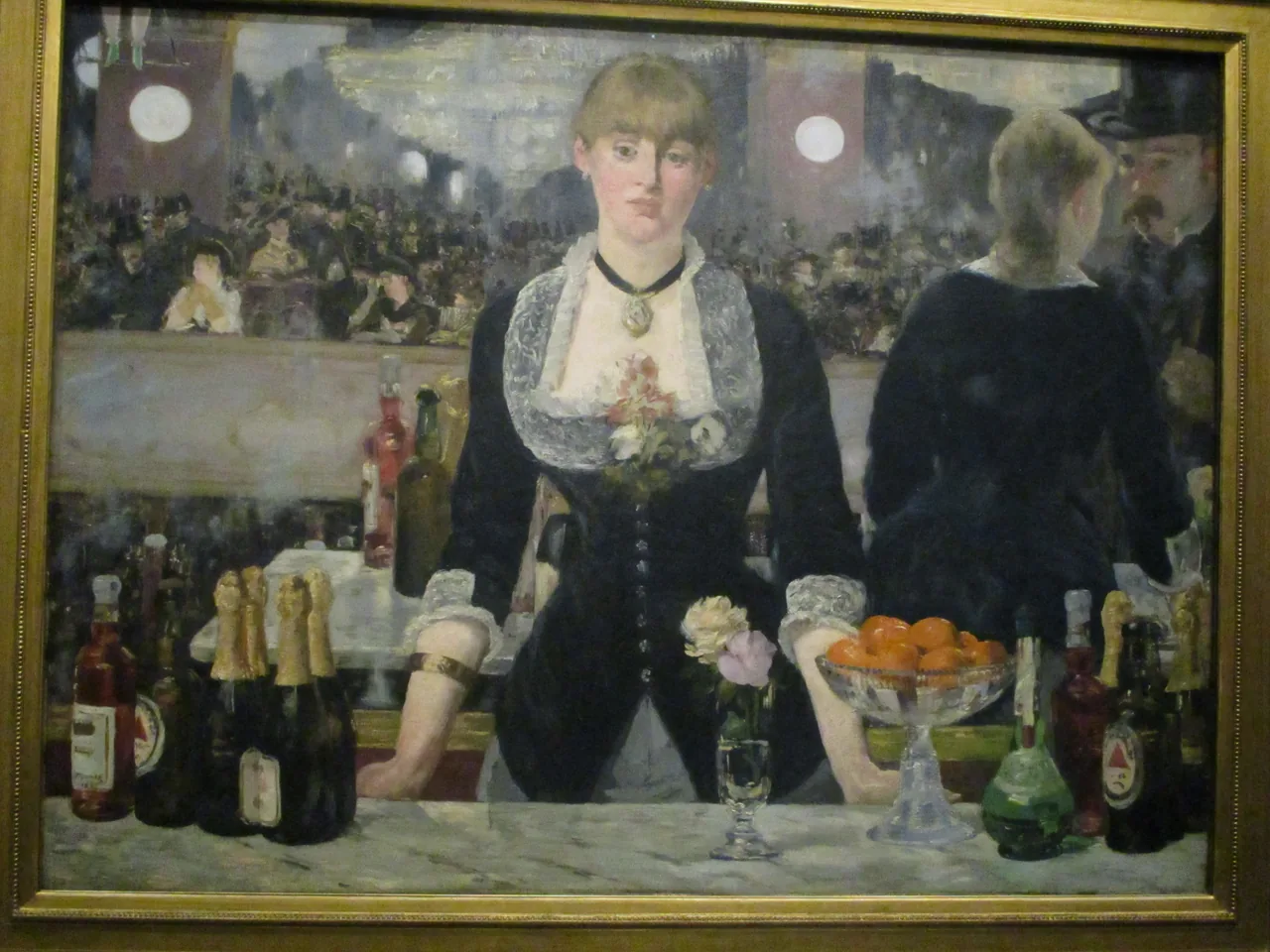
Follow the horizontal line behind the barmaid’s elbows. Above it, faces, lights and architecture fill a second space. At the right, the reflected woman leans towards a man. In the middle, the woman facing us stands with her hands set far apart. That combination makes the viewer’s position difficult to settle.
The picture also contains several competing kinds of brightness. White cuffs and lace sit against dark clothing; oranges glow near the right hand; the lights in the mirror are soft pale discs. A small flower arrangement interrupts the broad counter. The busy room and the comparatively still central figure pull in different directions.
A crop limited to the face loses that relationship. A crop limited to the bottles turns a complicated scene into a still life. Neither is wrong as a labelled detail, but the full composition should be available when the subject is the mirror or the barmaid’s position in the room.
Watch the outer edges too. The small green boots at the upper left are easy to dismiss as an accidental fragment. Removing them cleans up the corner but also removes part of the entertainment surrounding the central figure. A neat commercial rectangle can quietly change what a reader is able to notice.
The historical work and US publication
Manet died in 1883. His ordinary posthumous author term has expired under the UK government’s seventy-year summary. The Courtauld’s public-domain label supports the practical distinction between the historical canvas and its modern image services.
An American legal conclusion still needs the relevant publication history. The U.S. Copyright Office distinguishes displaying a work from distributing copies. The Salon appearance in 1882 therefore cannot, by itself, prove a qualifying publication that year.
This guide has not independently established the exact canvas’s early publication history. That does not contradict the museum’s public-domain assessment; it limits what we can independently prove about its U.S. route to that status. Do not convert “shown publicly” into “published everywhere”. For a project that demands a legal opinion, the unresolved publication history belongs in that review.
The Courtauld download is not CC0
The Courtauld’s collection policy offers images of public-domain works under CC BY-NC 4.0. Its object page separately labels the painting public domain while setting conditions for the image. Those are two different statements, not a contradiction that can be solved by ignoring one.
A museum can identify an old work as public domain and still present particular files through a licensed service. If your proposed use does not fit that service’s conditions, seek an appropriate licence or use another legitimately available file. A commercial project should not call itself non-commercial simply because its subject is educational.
Keep track of which route you choose. A screenshot of a zoom viewer does not become a new source with fewer conditions. Nor does finding a museum-supplied image on an unrelated website explain whether that website was entitled to redistribute it for your use.
The openly licensed photograph used here
Our illustration is Meissen’s photograph on Commons, made in 2019. The uploader identifies it as their own work and releases it under Creative Commons Attribution-ShareAlike 4.0. The photograph includes the frame; it is visibly a photograph of the object, not a newly painted Manet.
This licence permits commercial reuse as well as non-commercial reuse, with its conditions. Credit the photographer, link to the licence and indicate changes. If you share an adaptation, the applicable share-alike requirement also needs to be followed. The licence does not mean the photographer endorses your project.
For this page, we reduced the photograph proportionally for web display and changed its file format. We did not crop the composition, repaint it or alter its colours. The resulting image remains available under CC BY-SA 4.0. That change notice applies to the photograph, not to a claim that GeMarkt restored the canvas.
A useful image is not always a print master
The photograph works well for identifying the picture and discussing its overall arrangement. It also shows the limitations of a gallery photograph: the frame is present, the camera was not perfectly square to the canvas, and lighting affects the surface. An open licence does not certify colour accuracy or suitability for every print size.
For a large reproduction, assess the actual pixels, focus, perspective and lighting before committing to production. Do not enlarge a soft file and call the result a museum scan. If you need a different file, repeat the permission check rather than transfer Meissen’s licence to a sharper image from another source.
The same care improves editorial work. Describe the image you actually show. If a detail is difficult to see, link to the collection’s viewing page for study instead of pretending your small illustration reveals every brushstroke.
Credit the painting and the photograph
A compact credit is: Édouard Manet, A Bar at the Folies-Bergère, 1882. Courtauld Gallery, London, P.1934.SC.234. Photograph: Meissen, CC BY-SA 4.0, via Wikimedia Commons. Keep the source and licence links accessible, together with any change notice.
This approach lets you use the image without blurring two creators together. Manet made the painting. Meissen made the photograph. Your layout, caption or adaptation may add something further, but it does not erase those earlier layers or the conditions attached to the file you chose.
Editorial record
About this article
- Author
- Publisher
- GeMarkt
- Published
- Reviewed
- Internal source & rights check. Conducted by GeMarkt Research Review. This is an internal editorial check—not independent peer review.
- Source standard
- Rights guide source standardSeparates the underlying work from the source file, records the review date, and links the evidence used for the conclusion.
Found a claim that needs checking? Report a factual error.