GeMarkt Blog · Practical guide
Art Gifts for New Parents
Choose an art gift for the parents as well as the new arrival. Explore blossom, caregiving and garden images, with clear guidance to keep artwork away from the cot.


Choose art the parents would enjoy living with, and leave the final placement to them. A gift for a new arrival does not have to be nursery decoration, personalised with a name or designed to match a baby’s clothes. A familiar artist or a thoughtful image can mark the occasion without turning their home into a themed room.
Keep one boundary clear from the start: do not plan a picture above or within reach of the cot. The gift can go in another part of the home, or wait in protective storage until the parents have time to decide. There is no deadline for turning a present into a finished display.
Start with the parents not a nursery theme
Ask what would be welcome before choosing a large or personalised piece. Some families enjoy images of caregiving; others would rather receive a landscape that connects with their interests outside parenthood. Neither response needs explaining. A picture can acknowledge a new chapter without making a statement about how a family ought to look.
Avoid assumptions based on a baby’s sex, the family’s structure or a photograph of the nursery. Pink blossom is not automatically a gift for a girl, and a blue sky is not reserved for a boy. Similarly, a painting of one woman and child does not stand for every family’s experience.
You can keep the conversation easy: offer one familiar artwork and one less literal alternative. Ask whether they would prefer a framed print, a contribution toward something they choose or no decorative object at present. If practical gifts are the priority, respect that. Art should not create pressure to perform gratitude during an already busy period.
Almond Blossom has a real birth gift history
Van Gogh’s Almond Blossom, 1890, has a genuine connection to welcoming a child. The Van Gogh Museum’s gallery text explains that he painted it for his newborn nephew Vincent Willem. You can share that brief history without inventing a universal meaning for every flower.
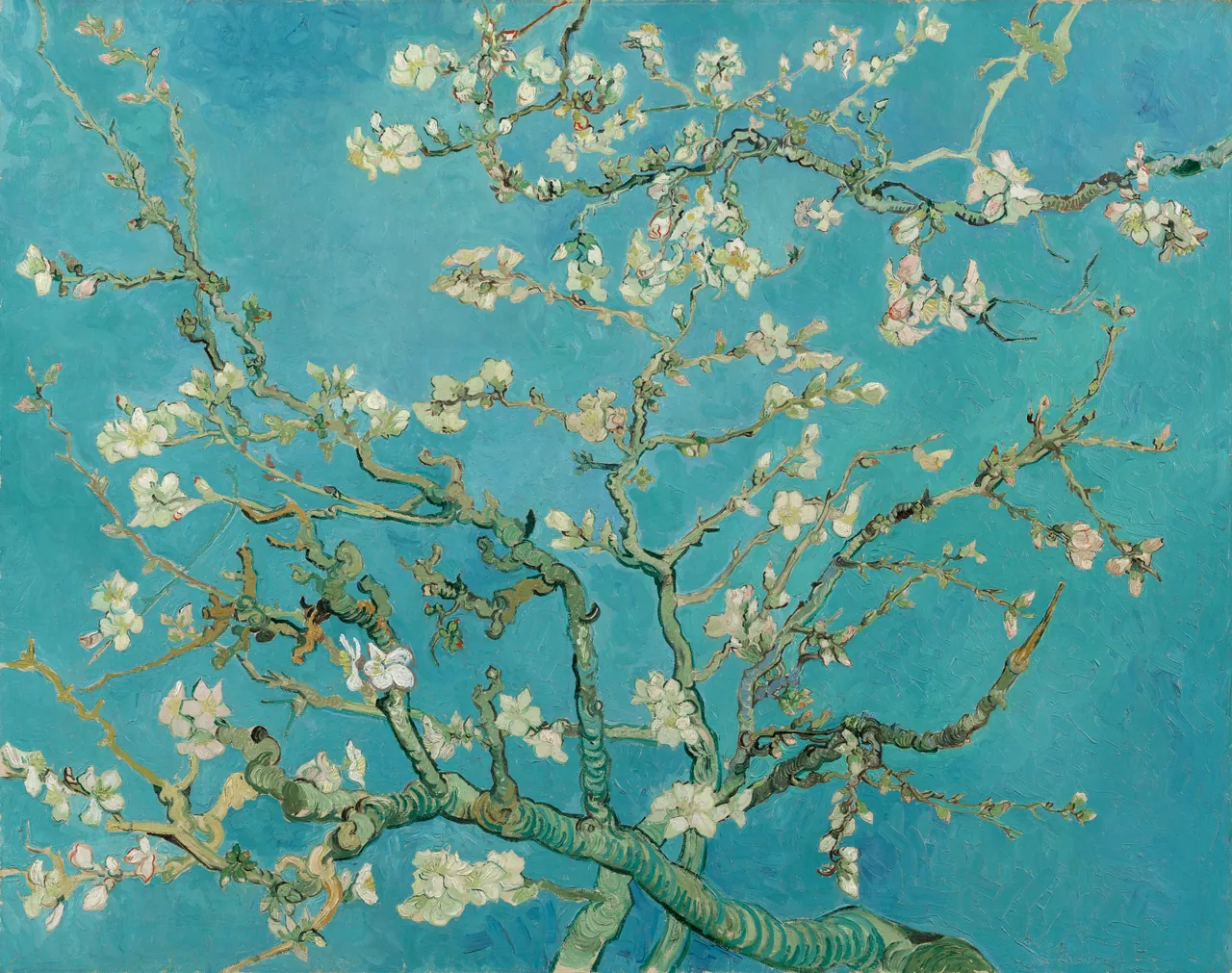
The composition offers more than a sentimental association. Its strongest branch enters from below, then divides into thinner stems. Flowers and buds occupy unequal patches of blue. It can be looked at closely without requiring the viewer to follow a busy narrative.
That is a description of the picture, not evidence that it improves sleep or development. Choose it because the family likes its shape, colour or story. A pale room might accommodate the blue as a prominent new colour; a room already full of blue could give the branches a different role.
Keep a personal dedication on a separate card unless the parents request text on the print. Names and dates placed over the branches change the artwork and can make the picture harder to move into another room later. Confirm every spelling before commissioning anything that cannot easily be changed.
Cassatt makes everyday care visible
Mary Cassatt’s The Child’s Bath, 1893, shows a woman holding a child while washing the child’s feet. The Art Institute of Chicago identifies this canvas as accession 1910.2. The child depicted is not a newborn, and the scene is not a demonstration of present-day infant care.
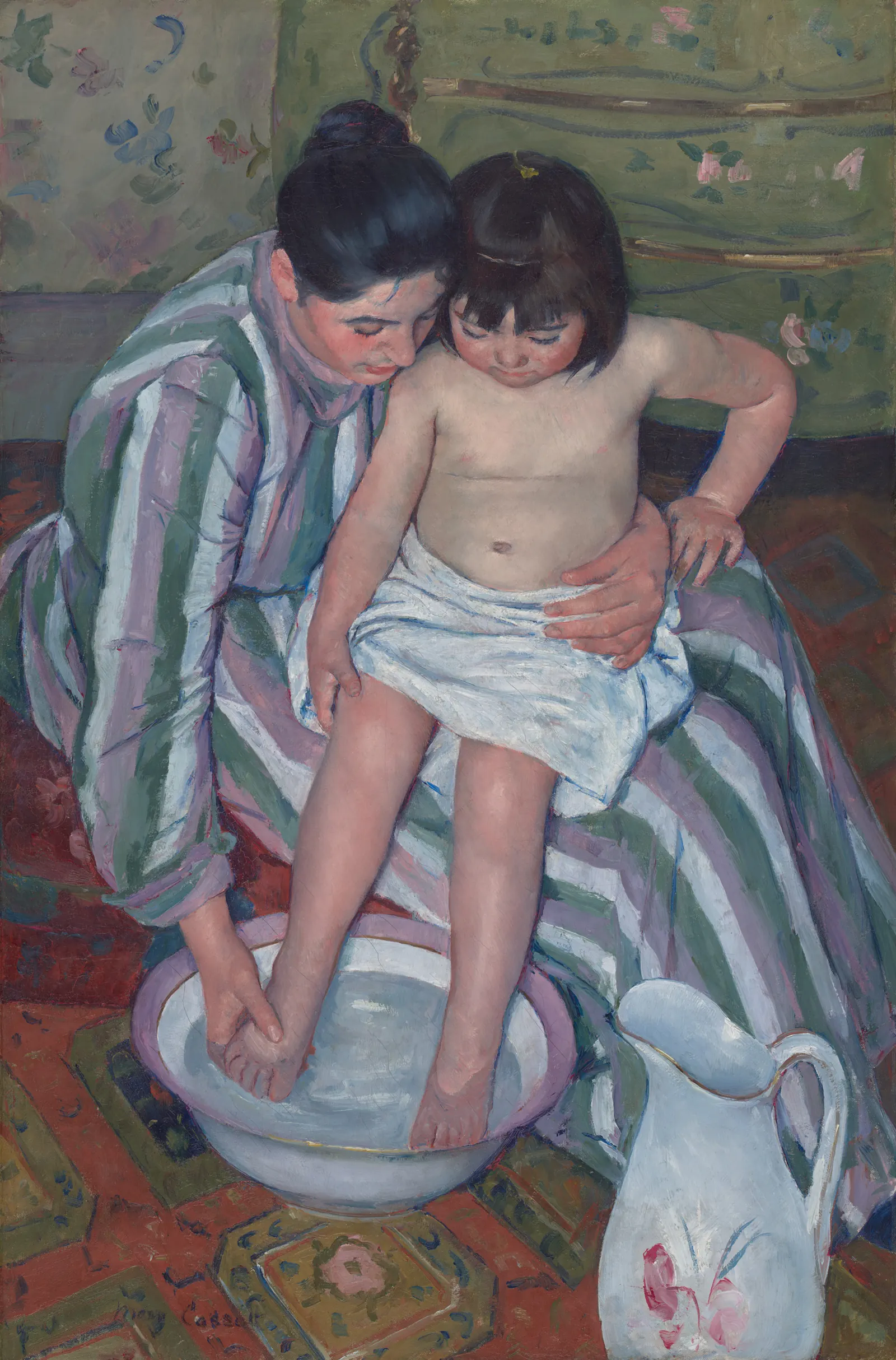
The two lowered heads and the supporting hand make care visible through an action rather than a ceremonial pose. Stripes, flowers and patterned flooring surround them, so the image has plenty to offer a person interested in design as well as family subjects.
Give this sort of picture only when its intimacy seems welcome. It may be meaningful to one recipient and too literal for another. Do not call it a portrait of the recipient’s relationship with their child or presume that a single caregiving arrangement represents their household.
A short note about noticing everyday attention could accompany it. There is no need to write an idealised account of parenthood, or to suggest that the new parents should resemble the composed figures in the picture. The historical painting is something to enjoy, not a standard to meet.
A garden can belong to the whole household
Hiroshige’s Plum Garden at Kamata, 1857, offers an alternative without babies or family symbolism. Its tall trees, blossom and small visitors make a place to explore visually. It is a plum garden, not a cherry-blossom scene.
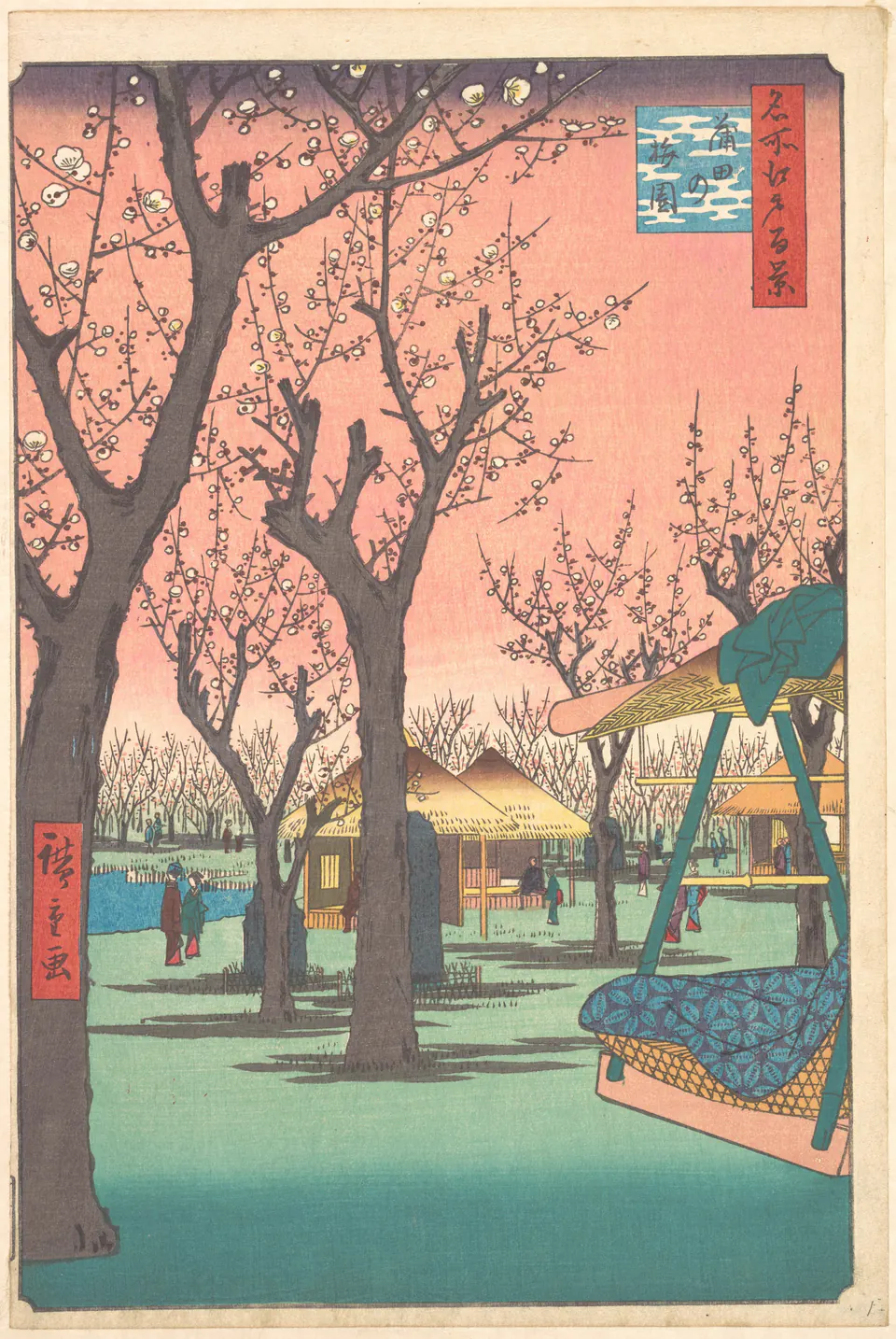
This could suit parents who already enjoy Japanese prints or gardens. The dark trunks give the image a strong structure, while the people invite a closer look. A small reproduction may work near an adult reading area; the tall format need not dictate a position in the nursery.
Notice how different it is from Almond Blossom. Van Gogh leaves the ground out of view; Hiroshige includes paths, buildings and visitors. Choosing between them is about which experience the family likes, not which image sounds more appropriate on a baby-gift list.
Keep art away from the cot
Health Canada’s nursery guidance advises keeping artwork and other wall decoration away from the crib: it can fall into the sleep space or be pulled down as a child becomes able to stand and climb. A frame being light, shatter-resistant or marketed for nurseries does not remove the placement question.
For this gift, choose a different wall or a different room with the parents. Do not substitute a leaning frame on nearby furniture or a cord-hung decoration. Check the complete arrangement as the child’s reach changes, and follow the actual frame, fixing and wall requirements. If the location cannot be assessed properly, keep the artwork uninstalled.
The goal is not to prescribe a universal hanging height. A measurement alone cannot account for the furniture, fixing, climbing opportunities and room layout. Leave those decisions to the household rather than including a photograph that encourages copying a decorative arrangement above a cot.
Avoid giving them an unfinished project
A digital file can look convenient to the giver while leaving the parents to find a printer, choose a size and arrange a frame. An unframed print may present a similar problem. Ask which format would genuinely reduce effort rather than assuming that the smallest parcel is the easiest present.
If you offer to arrange framing, confirm the complete size and finish first. The sheet size is not necessarily the visible image size, and neither tells you the outer frame dimensions. Our print-format guide explains what to check without treating one format as suitable for every setting.
Agree a delivery time and address. Avoid leaving a parcel that requires immediate collection or a large empty package to dispose of without warning. Put the care instructions and purchase details together, and retain the receipt yourself if that makes a later exchange easier. Check the seller’s actual terms before promising one.
Let the gift grow beyond the occasion
The artwork does not have to stay in the first place it is hung. A blossom painting might move to a hallway; a garden print may later join a collection in a study. Choosing an image the adults genuinely like gives it a life beyond a particular nursery scheme.
If you add a date or dedication, a separate card can travel with the picture without becoming part of its surface. A brief personal message is enough. You do not need to turn the work into a family emblem or predict the child’s future interests.
The most considerate version of this gift leaves the parents with choices: when to open it, whether to frame it, and where it belongs. Its value lies in being welcome, not in becoming another task that has to be finished before the next visitor arrives.
Editorial record
About this article
- Author
- Publisher
- GeMarkt
- Published
- Reviewed
- Internal source & rights check. Conducted by GeMarkt Research Review. This is an internal editorial check—not independent peer review.
- Source standard
- Buying guide source standardSeparates measured or first-hand evidence from general guidance and keeps practical limits visible.
Found a claim that needs checking? Report a factual error.