GeMarkt Blog · Practical guide
Honest Mockups vs Misleading Ones
Learn what an art-print mockup can show, what needs a real sample and how scale, frame, crop and canvas-edge previews can create misleading expectations.

A mockup is useful when it helps someone imagine a print without confusing that illustration with evidence of the finished product. The problem is not that an image is digital. It is that an attractive room, an invented texture or an unexplained frame can make promises the product information does not support.
This matters to buyers and sellers alike. A room view can suggest a colour pairing; a flat artwork view can reveal the composition; a supplier preview can represent a selected format. None automatically proves how the delivered object will look or feel. Here is how we separate those jobs at GeMarkt, and what to question in any art-print listing.
Give each image a specific job
Start by asking what a picture is supposed to explain. A full artwork image helps you inspect the subject. A room illustration helps you consider an arrangement. A close photograph of a named physical sample can provide evidence about that sample’s surface. These are useful but different things.
On our Monet Woman with a Parasol page, the room-gallery images are labelled as illustrative digital mockups, not photographs of the finished product. The gallery also includes the artwork itself. That separation lets a reader enjoy the room without having to extract the actual picture from a decorative setting.
A seller should be able to explain why each view exists. Five attractive room images do not replace one clear view of a cropped signature, a border or a frame. If the question is whether the whole composition fits a particular format, an unobstructed front view is usually more informative than another sofa.
Keep the artwork separate from the scene
For those Monet room illustrations, the room background and the artwork were separate inputs. The existing artwork file was placed into the scene at its own proportions, without cropping or repainting it. This is a description of that particular compositing process, not a claim that every image on the site uses the same method.
Keeping a verified artwork file separate prevents the room-making process from casually replacing a face, signature or brushstroke. It does not make the surroundings documentary. The furniture, shadows and apparent depth remain styling choices, not proof of a photographed print hanging in a real customer’s home.
There is also a difference between preserving the source image and verifying printed colour. A faithful digital insertion only establishes what went into that illustration. It does not establish the paper, ink, lighting or appearance of a manufactured item. Those questions need other evidence.
Make scale a number not a mood
A picture can appear comfortably large simply because it has been enlarged relative to the furniture. Without measurements, the viewer cannot tell whether it represents a small print or an enormous one. Even a convincing room does not solve that ambiguity.
The diagram below uses an assumed 200 cm sofa in both panels. A 60 cm-wide image is 30% of that width; a 100 cm-wide image is 50%. Those are arithmetic examples, not suggested universal sizes. Both diagrams use the same drawing scale and the same proportions for the abstract picture.
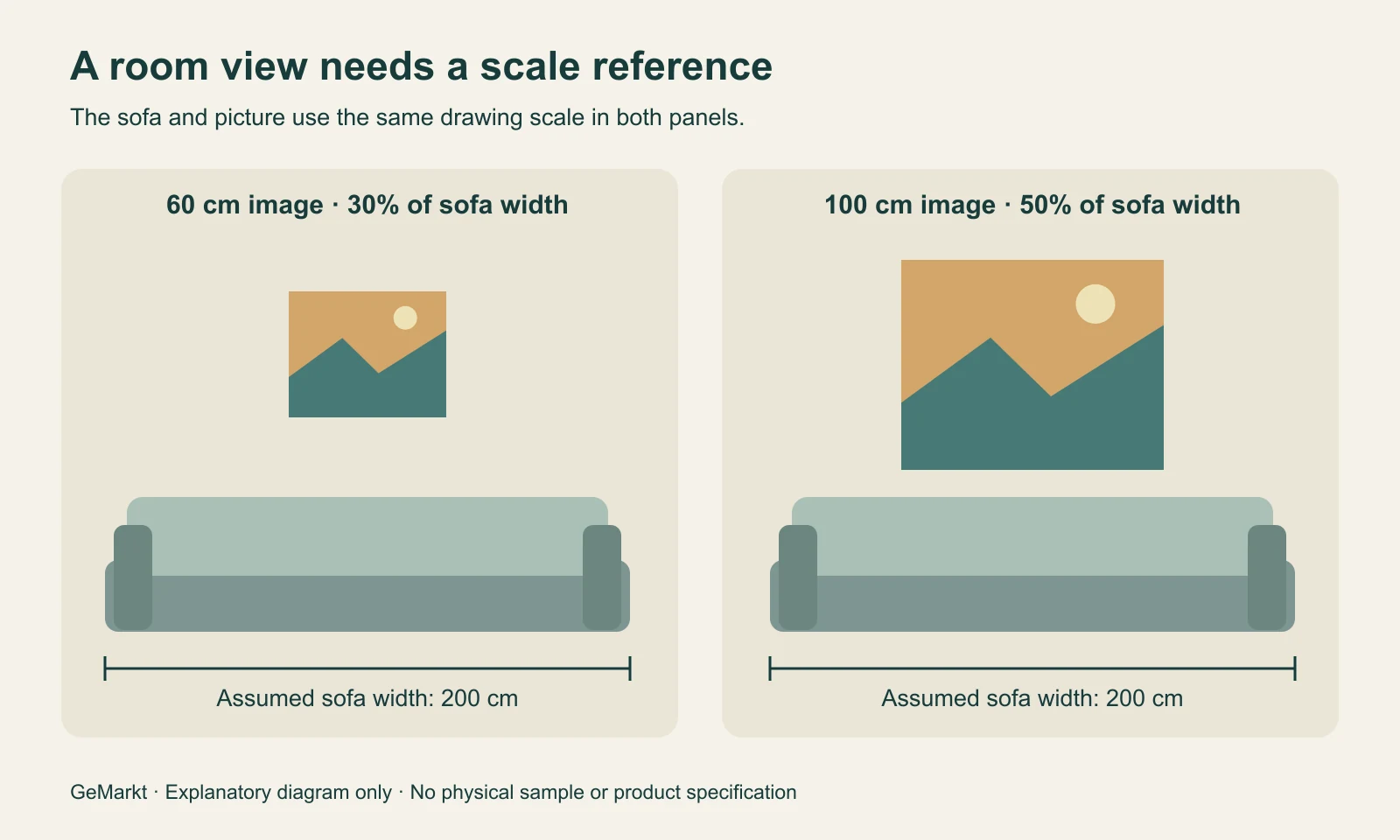
If the larger drawing were labelled 60 cm while the sofa stayed unchanged, the label and visual would disagree. A small disclaimer would not make the comparison useful. The remedy is to draw the correct scale or clearly abandon the claim that this is a measured view.
For your own wall, use its actual measurements and the print’s relevant outside dimensions. Camera perspective can complicate a room photograph, especially when the wall and furniture sit at different distances. A simple front-facing measurement sketch may answer the size question more reliably than a stylish perspective image.
Distinguish the image from the finished object
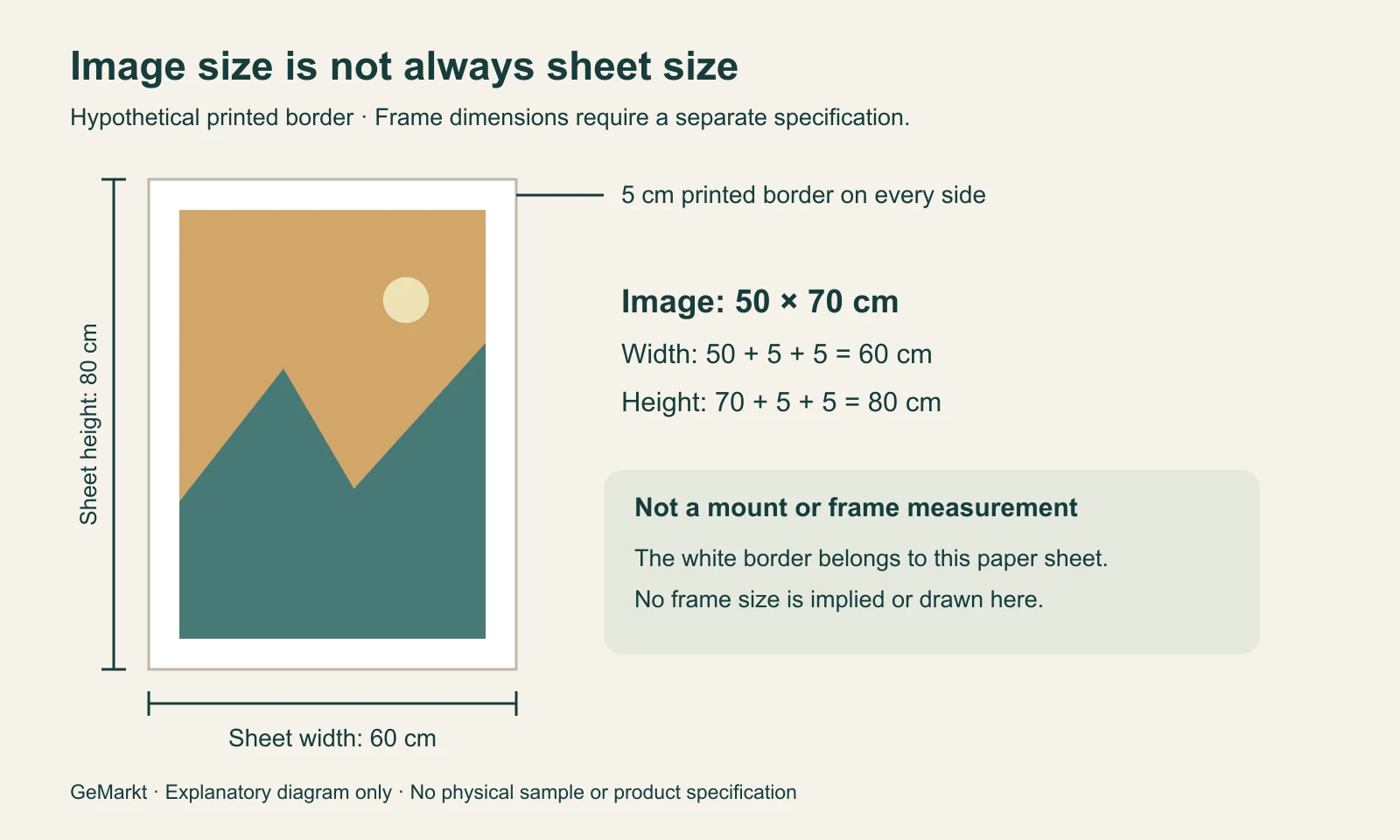
Size can refer to the picture, the sheet or the outside of a frame. Confusing them changes how much wall the finished piece occupies. A white area may be part of the print, a separate mount or merely empty space added in a mockup. The image alone may not tell you which.
Here is a deliberately simplified example. A 50 × 70 cm image, surrounded by a 5 cm printed border on every side, occupies a 60 × 80 cm sheet. Adding a frame is a separate calculation. Its outside dimensions depend on the actual frame construction; they are not supplied by the image or sheet measurement.
For canvas, the front and the sides add another distinction. An image wrapped around the sides is not the same presentation as a mirrored edge or an unprinted edge. A front-only picture cannot establish which was produced. A frame may hide an edge, but that does not make the underlying production choice irrelevant.
Explain which preview changes
An interactive selector creates an expectation: changing the option should make it clear what changes in the picture. A thumbnail assigned to a finish and size answers a narrower question than a room-gallery image that stays the same while you browse options.
Keep supplier mockups separate from geometric artwork comparisons. A geometric view can explain proportions without being a product mockup or production proof. An edge illustration is another separate view. If an illustration omits a frame to expose the canvas sides, it should say so: it does not describe what a finished framed item looks like.
A mirrored-edge supplier image does not become a different supplier image merely because an adjacent edge illustration changes. That distinction needs to remain explicit. If a matching mockup is unavailable, showing that limitation is preferable to silently substituting a nearby size and presenting it as exact.
The same principle applies at checkout. GeMarkt’s current previews do not automatically carry selections into Etsy. Final options must be chosen and checked there. A preview can still be useful, but it must not imply that an illustration has already become an order instruction.
Do not turn a render into a sample test
Printify explains that its mockups represent products rather than guaranteeing an exact match; colour and placement can differ. It recommends ordering samples to understand what the chosen provider delivers. That is the supplier’s advice, not evidence that GeMarkt has physically tested every combination.
A digitally added canvas weave does not prove the texture of the canvas being sold. A simulated highlight cannot establish a paper’s sheen. Nor does a warm room illustration prove how the colours will appear beside your window. Avoid upgrading “looks plausible” into “sample checked.”
If a seller presents a sample photograph, useful accompanying details include the actual format and size photographed. A sample can support observations about that object under those conditions; it cannot demonstrate that every future item, size or supplier will be identical.
Put the limitation where the choice happens
In its advertising guidance for small businesses, the US Federal Trade Commission considers implied as well as express claims. Disclosures should be noticeable, understandable and close to the claim they qualify; fine print cannot reverse a misleading overall impression. That is US guidance, not a complete statement of every country’s advertising rules.
For a print listing, the practical consequence is straightforward: put “illustrative room view” beside the room view, not only in distant terms. Explain an omitted frame beside the edge illustration. Identify the selected size beside the relevant preview. Keep the factual product details available where the buyer makes the choice.
Before using a mockup, ask what a hurried customer would think it proves. If the answer includes a size, frame, texture or test you cannot support, change the picture or its presentation. An honest mockup can be inviting. It just needs to leave the customer with the right expectation, rather than the most flattering one.
Editorial record
About this article
- Author
- Publisher
- GeMarkt
- Published
- Reviewed
- Internal source & rights check. Conducted by GeMarkt Research Review. This is an internal editorial check—not independent peer review.
- Source standard
- Blog source standardNames the editorial responsibility, keeps evidence close to material claims, and records meaningful revisions.
Found a claim that needs checking? Report a factual error.