GeMarkt Blog · Practical guide
Etsy or Your Own Shop? Selling Art Prints in 2026
Compare Etsy and an independent art-print shop through dated fee examples, discovery, product presentation and operating work, without profit promises.

Choose between Etsy and an independent shop by comparing the complete selling job, not one commission percentage. An art-print buyer needs to find the work, understand the size and format, trust the listing and receive support after paying. A cheaper-looking checkout does not solve the other parts automatically.
This guide uses official information checked on 13 October 2026. The worked Etsy example is for a US bank-account fee schedule, in US dollars, not a statement about GeMarkt’s account or any reader’s country. Prices and policies can change; check the linked terms before making a commitment. Nothing below forecasts sales, profit or advertising returns.
Separate the jobs before choosing the channel
A marketplace puts your listing inside a shared shopping environment. Your own site gives you a place to organise the story around the product. Neither description proves how many people will arrive or buy. Treat discovery, presentation and ordering as separate questions before deciding that one channel replaces the other.
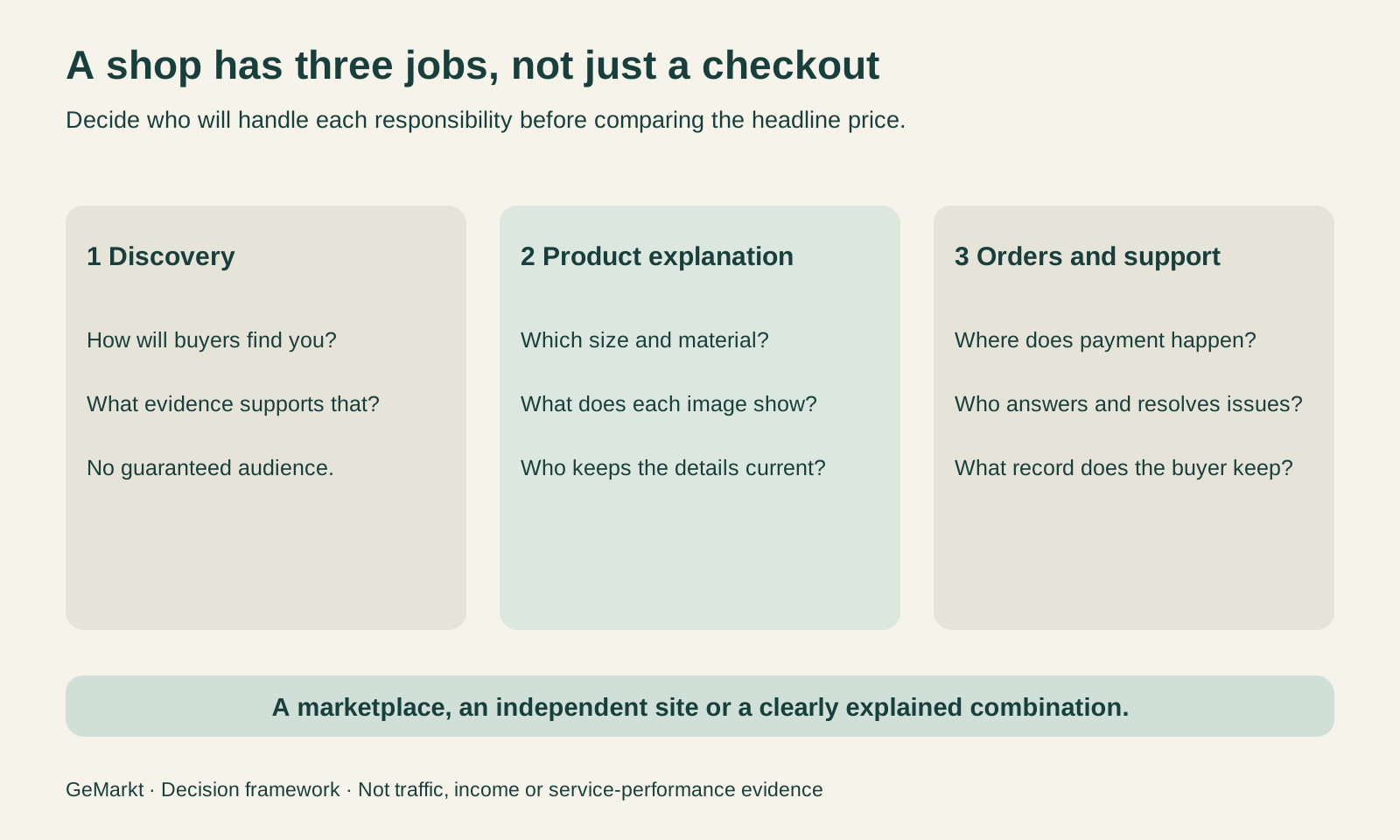
For an art print, presentation includes more than a title and attractive room scene. Can the buyer distinguish paper from canvas, identify the selected dimensions and see whether the composition changes? An independent site can devote space to those explanations; it also creates more information that someone must keep accurate.
GeMarkt currently separates some of those jobs: our site provides articles and product previews, while the purchase links complete checkout on Etsy. That is a description of the current arrangement, not evidence that we have measured a standalone checkout against Etsy or proved one more profitable.
Price one order not just one percentage
Etsy’s current fees policy lists a US$0.20 listing charge and a 6.5% transaction fee on the listed price plus charged shipping and gift wrapping. Listings can generate further renewal charges. Payment processing is additional, not included in that percentage.
For the US, the Etsy Payments schedule is 3% plus $0.25, assessed on the payment total including shipping and applicable sales tax. Consider one $45 print with $5 charged shipping, no sales tax, and one $0.20 listing charge allocated to it. The transaction fee is $3.25; processing is $1.75. Together with the listing charge, that is $5.20.
That leaves $44.80 before production, actual postage, packaging, labour and other costs. It is not profit. The example excludes advertising, other renewals, setup charges, taxes on fees, currency conversion, refunds and any other applicable charges. Its purpose is to show why a single headline rate is not a complete order calculation.
Allow for advertising and country differences
Etsy’s Offsite Ads guidance describes an additional fee on attributed orders: generally 15% below its $10,000 threshold, with eligible shops able to opt out, and 12% with required continuing participation once the threshold is reached under its rules. Attribution can follow a click for 30 days, with an Etsy Ads last-click exception. This is not an extra fee on every order.
Do not copy the US processing example into another country’s spreadsheet. The linked payment schedule bases rates on bank-account location; it currently lists Türkiye at 6.5% plus 14 TRY. Applicable taxes, deposit conditions and other local charges need separate attention. That single difference can change a comparison before you have considered the cost of obtaining a customer.
Use actual account statements to learn which charges occur in your circumstances. Keep ordinary orders and ad-attributed orders separate, rather than using the best-looking order as the expected result for everything you sell.
Give the independent shop a real cost column
“No marketplace commission” does not mean “no selling cost.” An independent shop still needs a workable payment arrangement, maintenance, customer communication and a way for people to find it. Some costs are cash payments; others are tasks that consume time even when no invoice arrives.
As one platform example, Shopify’s billing documentation distinguishes recurring plan and app charges from usage-based and one-time charges, including domains or themes. Obtain a current quote for your location and chosen configuration. A promotional headline or a price displayed for another country is not an operating budget.
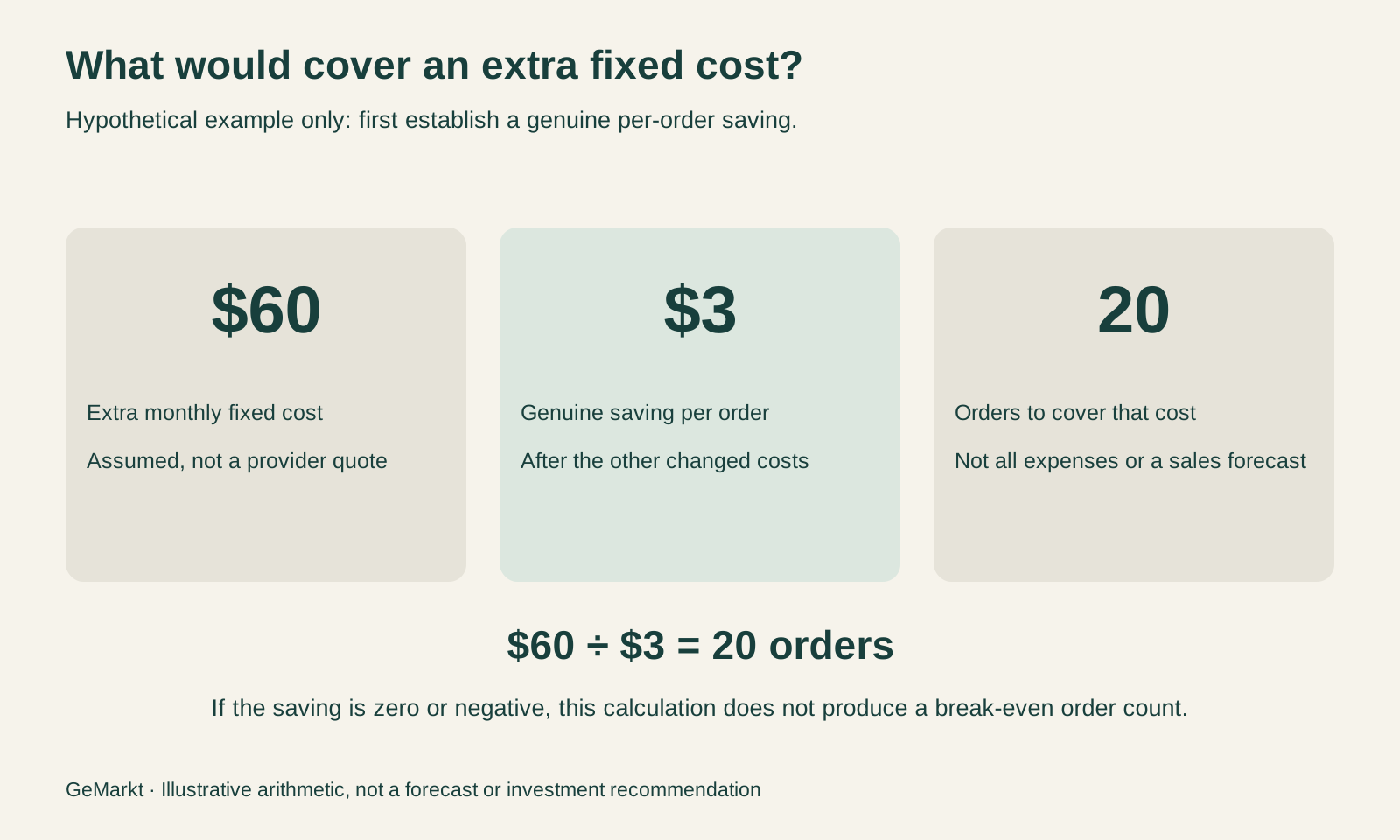
The word “genuine” matters in that diagram. A supposed per-order saving disappears if a new payment charge, support burden or acquisition cost absorbs it. Keep the product and service level comparable before attributing a difference to the channel. Otherwise you may be comparing a framed print with an unframed print, not two ways of selling the same thing.
Check whether the product belongs on the platform
Copyright permission and marketplace eligibility are separate questions. Etsy’s Creativity Standards require qualifying creative involvement; their designed-by category covers sellers’ original designs, including disclosed production-partner arrangements. It does not make a scan or bundle of someone else’s work an original seller design merely because the underlying art is old. A newly manufactured reproduction is not a vintage object simply because its image is centuries old.
Before building a catalogue around a platform, check the actual item against its current categories and disclosure rules. A permissive image licence cannot answer that platform-policy question for you. Equally, an accepted listing does not establish that the image rights have been cleared.
On either channel, make product claims specific. Show the selected format, distinguish an illustrative room from a physical sample and explain a crop or border. Our honest-mockup guide covers those presentation choices; changing the checkout destination does not make them less important.
Use two channels without moving Etsy transactions
A combined approach needs clear boundaries. Etsy’s off-platform rule prohibits moving an Etsy transaction outside its platform. An independent website is not a justification for asking an Etsy shopper to avoid the marketplace checkout.
Customer information needs similar care. The seller policy limits how information received through Etsy may be used; an order is not automatic permission to add someone to an external marketing list. Build any independent audience through an appropriate, explicit signup rather than treating customer addresses as a transferable mailing database.
For customers, the handover should also be understandable. Say where payment happens, where final options are selected and which order record they should keep. In GeMarkt’s current previews, a local selection is not a promise that Etsy opens with that variation selected. This is a practical limitation to disclose, not hide behind a smooth-looking button.
Choose from observed results not a promise
Begin with a small, complete comparison: one accurately described product, its real production and shipping cost, relevant channel charges and the work required to support it. Record what happened, including enquiries that revealed confusing sizes or mockups. An attractive page with unresolved fulfilment questions is not ready merely because the checkout functions.
If you already have an independent audience, investigate how that changes your options without assuming every follower will buy. If discovery is uncertain, treat it as an unanswered part of the plan. Neither a marketplace listing nor a new domain guarantees attention.
The useful decision may be staged rather than permanent. Keep the channel that serves a clear purpose, improve the part that is genuinely limiting the buyer and revisit the costs with evidence. That is a better reason to change a shop than a promise that owning the payment button will, by itself, make selling art profitable.
Editorial record
About this article
- Author
- Publisher
- GeMarkt
- Published
- Reviewed
- Internal source & rights check. Conducted by GeMarkt Research Review. This is an internal editorial check—not independent peer review.
- Source standard
- Blog source standardNames the editorial responsibility, keeps evidence close to material claims, and records meaningful revisions.
Found a claim that needs checking? Report a factual error.